

Lexile 是美国教育研究机构 MetaMetrics 开发的英语阅读分级体系。1984年,两位教育测量学研究者 A. Jackson Stenner 和 Malbert Smith 开始研究一个问题:能不能用同一把尺子,同时衡量一个读者的阅读能力和一本书的文本难度?经过十多年的研究,这套体系在1990年代正式推向市场,此后逐渐成为英语世界覆盖最广的阅读分级标准。
它的计算逻辑并不复杂,把文本切成若干段落,分析每段的词频(这个词有多常见)和句子长度,计算出对应75%理解率的数值(为什么选择75%?因为理解率约为75%的时候,读者不是全懂,也不是读不下去,是有挑战但能继续读下去的状态)。
Lexile值的单位是"L",分值从0L(0L以下标注为BR,Beginning Reader)一直延伸到1600L以上。
MetaMetrics的建议是:选书时找低于自身水平100L到高于50L之间的区间,这是最适合当前阅读的区间。
There are still a few days until the Easter holiday, and the kids will soon enjoy a two-week break. I've already booked my travel itinerary well in advance, but there's still one task that gives me the most trouble every time—packing everything my child needs for the trip.
In the past, I let him bring a Switch, an iPad, even a phone, but it always ended up with him losing interest in sightseeing and trying local food, fixated solely on his electronics. So later on, I completely banned any game-enabled electronic devices from his travel bag.
Although I didn't intend to turn the holiday into study time, there are always waiting periods on the road—waiting for flights, for food to arrive, for queues—and kids tend to wake up earlier than adults at hotels. So I started letting him bring a Kindle instead; having a book he can actually get into is far better than scrolling videos or playing games.
So here's the question: what books should go into his Kindle for a short holiday trip?
If I pick books purely based on his interests and instincts, I tend to go too far in either direction—if the books are too hard, he gives up after two pages; if they're too easy, he finds them boring. That's why I decided to look into whether the IB curriculum offers any reading recommendations or guidelines for children.
How IB Approaches "Reading"
The simplest scenario would be if IB published a reading list for each age group, and I could just buy those books. But in reality, after searching through the relevant materials, I found that there is no officially designated reading list for the MYP stage (ages 11–16).
However, for the DP stage, IB does publish an official Prescribed Reading List (PRL), featuring hundreds of authors from around the world. Teachers select authors from this list, then choose one work by each author to form their course reading lists.
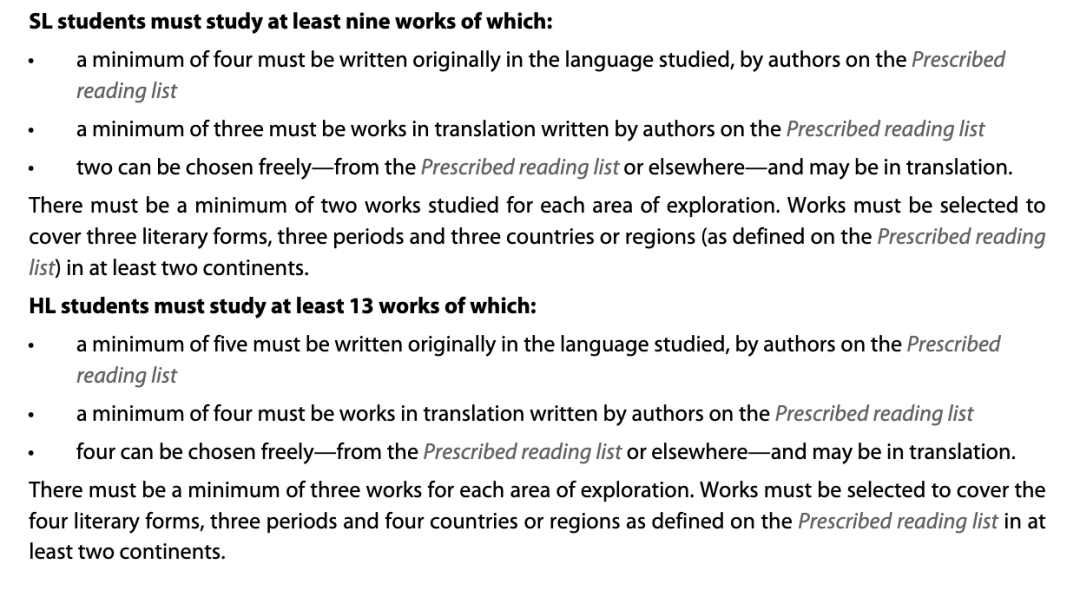
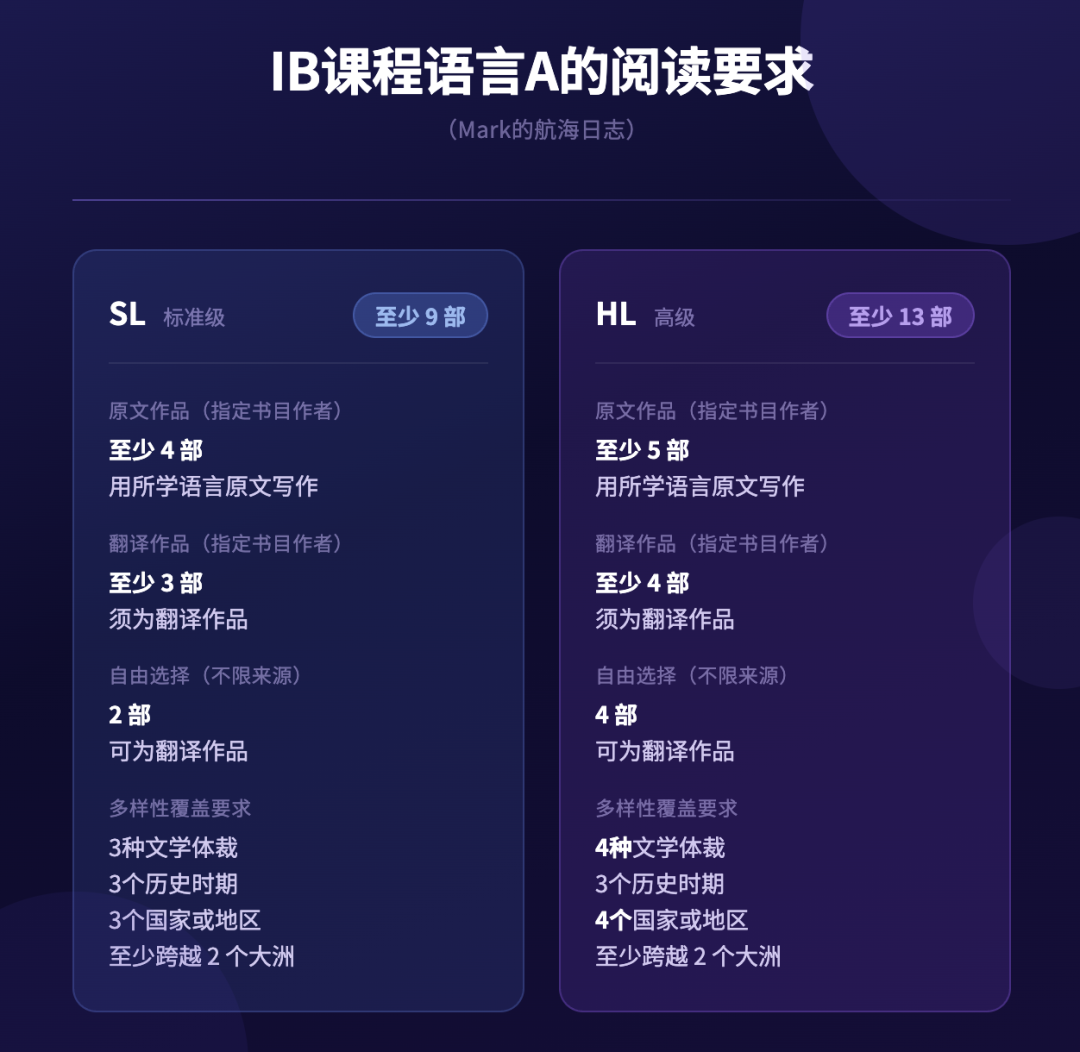
Based on the Language A curriculum requirements, I discovered that the reading demands for DP students are quite high.
I've summarized the key points from the above IB official requirements:
As you can see, DP students have a substantial reading load. If a child wants to adapt more smoothly and quickly during the DP stage, they need to build up their reading volume and strengthen their reading skills during the MYP stage.
So the question becomes: how do we choose books at the right difficulty level for our children?
Since IB has no designated reading list for the MYP stage, how can I find books that match my child's level? Through some research on my own, I discovered that there are indeed organizations working on this, and they've developed a universal "ruler" for measuring book difficulty—called Lexile.
Lexile is an English reading levels system developed by the U.S. educational research organization MetaMetrics. In 1984, two educational measurement researchers, A. Jackson Stenner and Malbert Smith, began investigating a question: could a single ruler simultaneously measure a reader's ability and a book's text difficulty? After more than a decade of research, the system was officially launched in the 1990s and has since become the most widely used reading level standard in the English-speaking world.
Its calculation logic isn't complicated: the text is divided into several passages, and for each passage, word frequency (how common the words are) and sentence length are analyzed to produce a score corresponding to a 75% comprehension rate. (Why 75%? Because at around 75% comprehension, the reader isn't fully understanding everything, nor are they completely lost—it's the sweet spot where the material is challenging but still readable.)
Lexile values are measured in "L" units, ranging from 0L (below 0L is labeled BR, for Beginning Reader) all the way up to 1600L and beyond.
MetaMetrics recommends selecting books within the range of 100L below to 50L above the reader's own level—that's the optimal zone for current reading.
Lexile Levels by Child's Age
Now that we have the Lexile tool, we should use our child's own Lexile score to select books. For example, my child's school administered a corresponding assessment, and at the beginning of this semester, his measured Lexile level was 1035L–1185L.
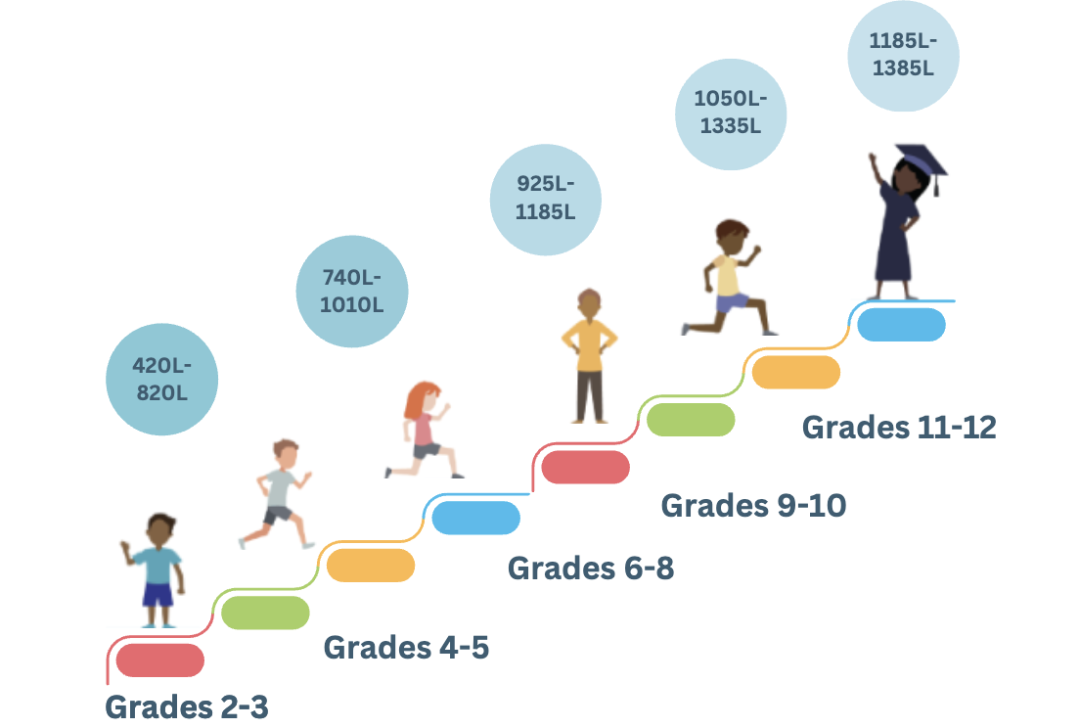
But how do I know whether my child's Lexile level is appropriate for their current stage—has he met the standard or not? I continued researching and found the following reference chart, which roughly shows the Lexile ranges for reading levels by grade.
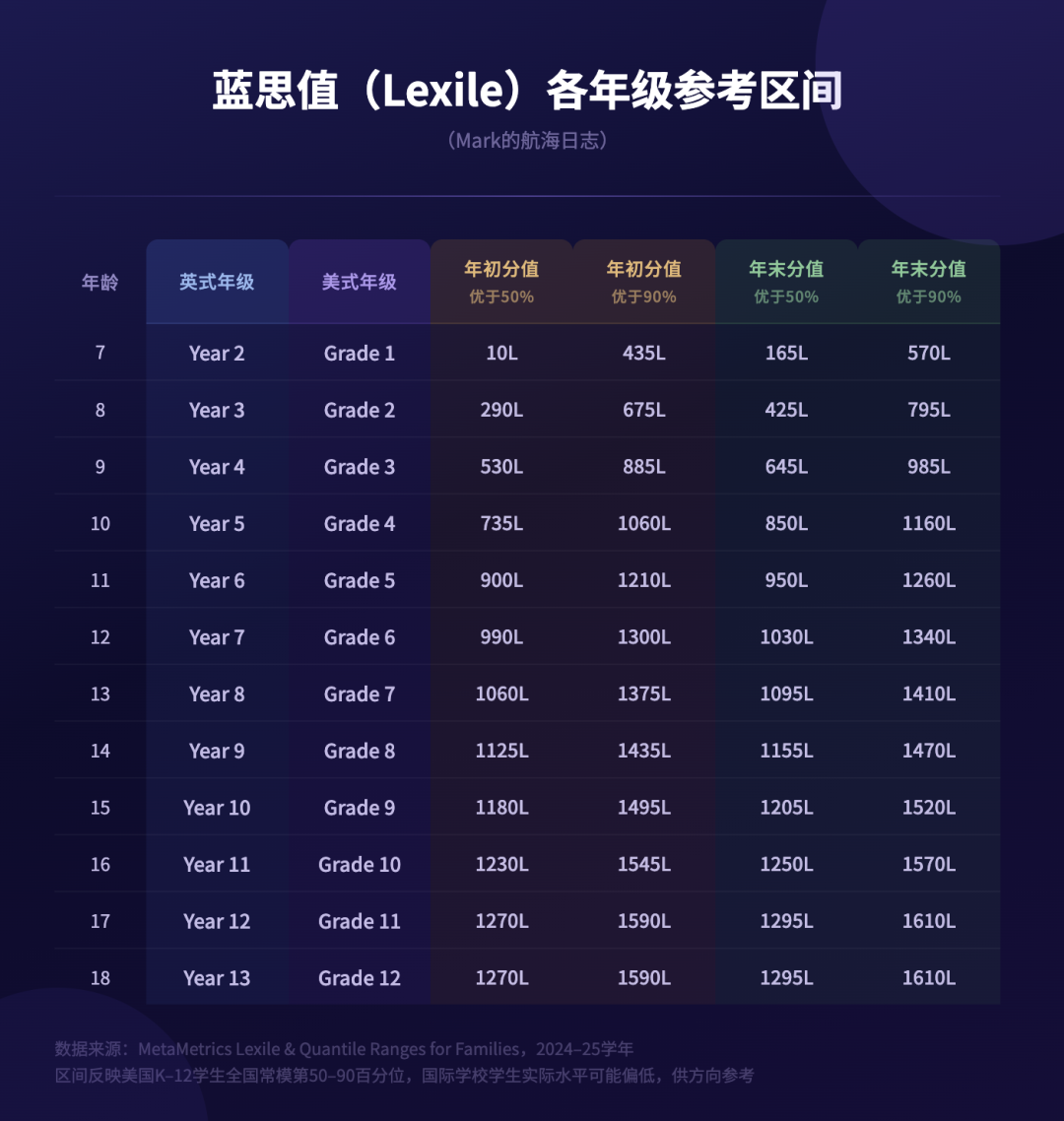
However, the chart above is too general. To get a clearer picture of reading levels by age, I found another set of official Lexile data from a 2024–25 survey conducted by Lexile on over 3 million students across the United States.
Since some families attend British-style schools and others attend American-style schools, grade nomenclature varies. I've organized the official data by Lexile score and corresponding age to make it easier for everyone to use.
Two things to note: First, the intervals for adjacent grades overlap, which is normal—reading development is a continuous progression, not a series of rigid breaks. Second, this data is based on U.S.-based student samples; children in international schools typically don't have English as a first language, so their actual Lexile levels may run somewhat lower. Use this chart as a directional guide rather than applying it too strictly.
If you want your child's reading ability to reach the average level of U.S. students, choose books based on the Lexile value that outperforms 50% of students. If you'd like your child to excel further, you can confidently select books based on the Lexile value that outperforms 90% of students.
How to Check a Book's Lexile Value
Now that I have my child's Lexile score and the Lexile organization's percentile ranges, the next step is figuring out how to find the Lexile value of a particular book.
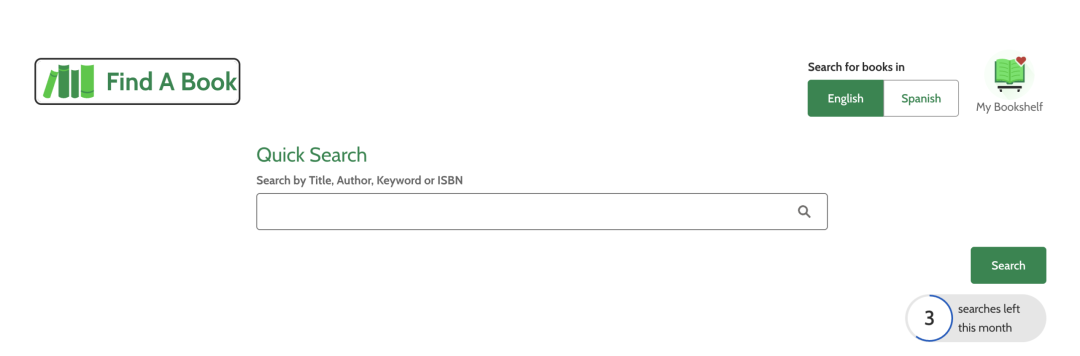
This is very convenient—it's available right on the MetaMetrics website. The query tool can be found at: https://hub.lexile.com/
On the website, just click the "Find a Book" button to enter the search page, then type in the book title. It's very straightforward.
Alright, I'm off to pick out books for my child's Easter trip reading list. I hope this article helps all the parents who care about their children's reading.
That wraps up today's learning notes from a stay-at-home dad. I'll share more insights in the next post.
"Not afraid of floating clouds obscuring my view, for I stand at the highest level." A parent's vision illuminates the boundaries of a child's exploration. Rejecting laziness and committing to continuous growth are what allow us to steer the right course for our children through the fog. I'm Mark—let's work together to be the navigators of our children's education.