
物联网的爆发式增长催生出多样化的无线传输需求,智能设备、智能家居、工业4.0、智慧城市等不同应用场景对速率、功耗、距离、成本提出差异化要求,从而推动了Wi-Fi/ Bluetooth/ UWB/ LoRa/ ZigBee/ RFID等多种无线传输技术的共存与互补。
无线传输技术核心特点对比:
-
速率:Wi-Fi(Gbps)> UWB > Bluetooth > ZigBee > RFID > LoRa(kbps)。
-
功耗:LoRa/ZigBee/RFID无源标签极低,Wi-Fi较高。
-
距离:LoRa(km)> Wi-Fi/ Bluetooth/ ZigBee(10–100m)> UWB(<50m)> RFID(1–100m)。
-
定位精度:UWB(cm级)> Bluetooth/Wi-Fi(m级)> LoRa(粗定位)。
01 Wi-Fi无线网络
-
常用频段:2.4~2.5GHz/5~7.125GHz
-
核心优势: 高带宽、高速率,是互联网接入和局域网内大数据量传输的主流技术。
-
特点: 功耗相对较高,覆盖范围中等,需要接入点(AP/路由器)构建网络。最新标准(如 Wi-Fi 6/6E/7)显著提升了速度、容量和效率。

表1 WI-FI各制式特性
-
典型应用场景:家庭/办公网络、8K高清视频传输(Wi-Fi 6/7)、AR/VR设备互联、智能家居互联等。
-
未来演进趋势:向工业物联网(IIoT)扩展,支持高可靠低时延(Wi-Fi 7的MLO多链路聚合技术)。
-
艾为电子适配WiFi的RF Switch产品,具有超快切换时间、低插损(0.2~0.55dB,优于友商7%以上)、封装形式丰富等优势。
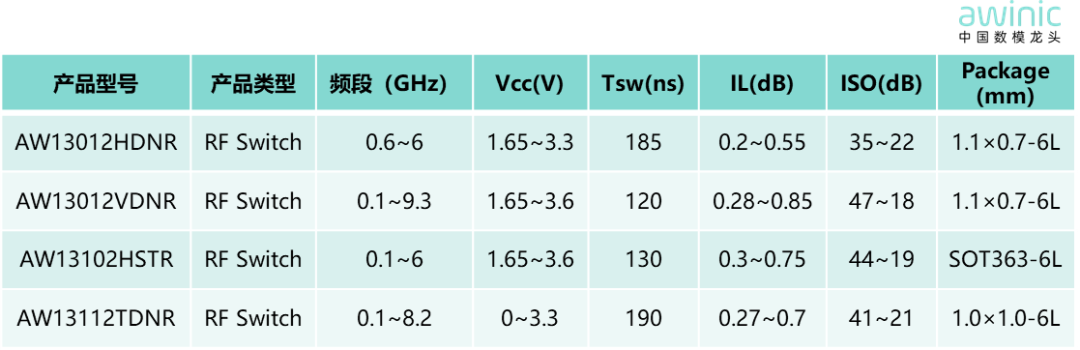
表2 艾为适配WiFi的RF Switch产品特性
02 Bluetooth蓝牙
-
工作频段:2.4~2.4835 GHz
-
核心优势:低功耗(尤其 Bluetooth Low Energy - BLE)、设备间短距离点对点连接简便、成本低。
-
特点: 传输速率适中,覆盖范围短(经典蓝牙约10米,BLE可更远)。BLE 特别适合需要长期运行、电池供电的设备。支持多种配置文件(Profile)实现不同功能(如音频 A2DP, 键盘 HID)。
-
典型应用场景:
BLE:可穿戴设备(心率监测)、室内导航(Beacon)、Mesh照明控制。
经典蓝牙:无损音频(LE Audio)、多设备同步(如耳机+手表)。
-
未来演进趋势:LE Audio支持多声道广播,蓝牙Mesh覆盖大型建筑(如楼宇自动化)。
-
艾为电子专为Bluetooth量身打造的LNA AW15019FDR,支持蓝牙4.0到蓝牙5.4全版本,可提升终端设备2dBm左右接收灵敏度和提升20%左右覆盖范围。

表3 艾为Bluetooth LNA AW15019FDR产品特性
03 UWB超宽带
-
常用频段: 3.1~10.6GHz
-
核心优势:厘米级高精度测距与定位、高数据传输速率(短距离内)、强抗干扰能力。
-
特点:使用极宽的频谱,故名“超宽带”,和极低的功率谱密度传输信号。信号穿透能力较差,有效距离很短(50米内)。
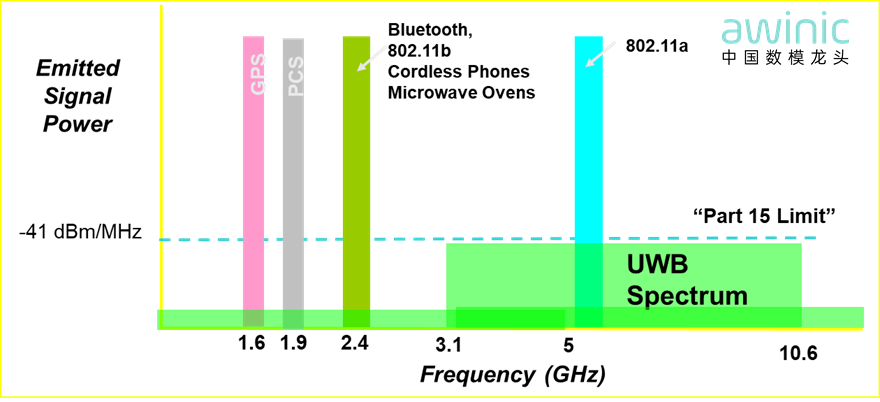
图1 功率谱密度图示
-
典型应用场景:
定位:AR室内导航(商场/机场)、工厂AGV实时跟踪。
交互:安全数字钥匙(无钥匙进入汽车/家门)、VR手柄毫米级追踪。
-
未来演进趋势:与5G融合(高精度定位服务),车载雷达(儿童遗留检测)。
-
艾为电子适配UWB的RF Switch产品,具有车规认证、超带宽和低插损等优势。
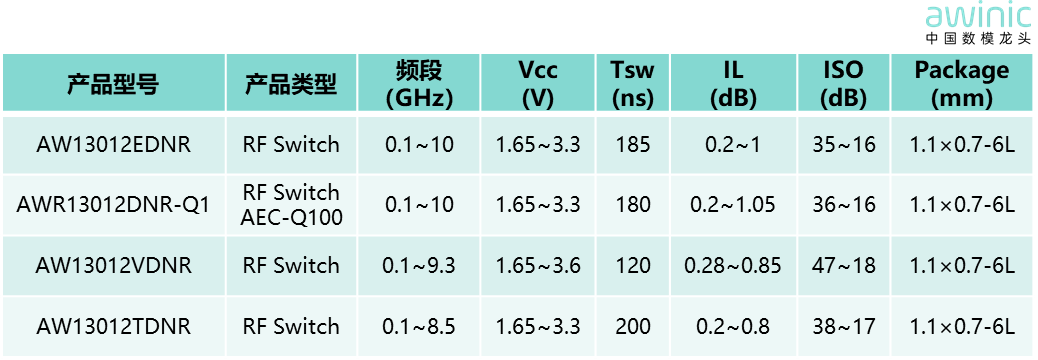
表4 艾为适配UWB的RF Switch产品特性
04 LoRa远距离无线电
-
常用频段:433~928MHz
-
核心优势:超长传输距离、超低功耗、强穿透能力。
-
特点: 传输速率非常低,主要用于传输小数据包(如传感器读数)。工作在 Sub-GHz 低频段,穿透障碍物能力强。通常与 LoRaWAN 网络协议结合使用,构成低功耗广域网。
-
典型应用场景:
广域物联网:远程水表抄表、环境监测(省电+长距)。
城市应用:智能垃圾桶满溢检测、共享单车电子围栏。
-
未来演进趋势:卫星直连(LoRa in Space),地下管网监测(强穿透性)。
-
艾为电子适配Lora的RFFE产品,具有低功耗(20μA,优于友商20%以上)、低损耗和封装形式丰富等优势。

表5 艾为适配Lora的RFFE产品特性
05 ZigBee无线个域网
-
工作频段:779~928MHz/2.36~2.5GHz
-
核心优势:低功耗、网状网络、高可靠性、低成本
-
特点:工作频段主要使用 2.4GHz(全球通用),也支持 868MHz(欧洲)、915MHz(北美);传输速率较低250 Kbps,适合小数据量传输。
-
典型应用场景:
智能家居:Matter协议支持多品牌互通;适合电池供电的智能设备
工业:智慧零售;无线传感器网络(温湿度/振动监测)。
-
未来演进趋势:向Thread协议迁移(基于IPv6),提升与IP网络兼容性。
-
艾为电子适配ZigBee的RFFE产品,具有低功耗、低损耗和封装形式丰富等优势。

表6 艾为适配ZigBee的RFFE产品特性
06 RFID无线射频识别
-
常用频段:125~148.5KHz/ 13.553~13.567MHz/ 433MHz/ 858~930MHz/ 2.4~2.483GHz
-
核心优势:非接触识别、批量读取、环境适应强
-
特点:
无源 RFID:无需电池,靠读写器电磁场供电(成本低、寿命长)。
有源 RFID:自带电池,主动发射信号(识别距离远,可达百米)。
半无源 RFID:电池仅用于芯片工作,信号由读写器激发。
-
典型应用场景:
无源标签:公交卡支付、门禁系统、物流托盘追踪等。
有源标签:冷链运输温控追踪(电池供电+传感器)。
-
未来演进趋势:与传感器融合(温湿度+位置),防伪溯源(NFC加密标签)。
-
艾为电子适配RFID的RF Switch产品,具有超快切换时间(120ns,优于友商20%以上)、低插损、封装形式丰富等优势。
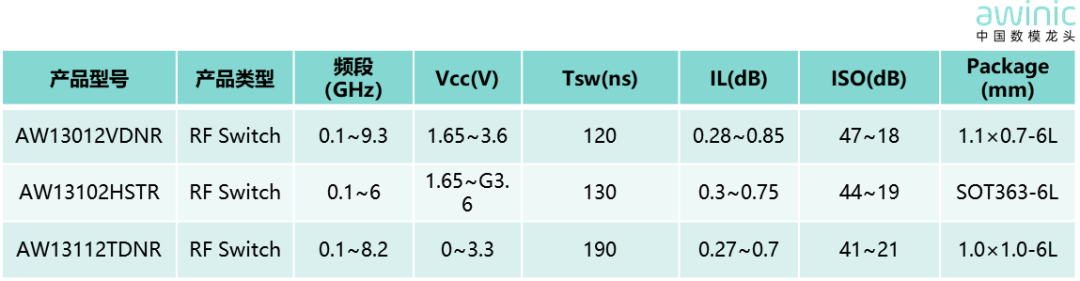
表7 艾为适配RFID的RF Switch产品特性
物联网的无线传输技术生态已从“单点突破”转向“协同进化”,未来需通过标准化、融合化和智能化进一步释放技术潜力。艾为电子在Wi-Fi/Bluetooth/UWB/LoRa /ZigBee/RFID等无线传输技术上的射频前端产品布局完备:超宽频、超低功耗、超快切换时间、低损耗的芯片产品矩阵,已构建起覆盖多场景、多频段、高性能的无线传输解决方案。
艾为电子射频产品线布局涵盖消费电子、工业互联和汽车市场三大核心领域,通过差异化设计满足各类无线传输多样性和互补性的需求。
The explosive growth of the Internet of Things (IoT) has generated a wide range of wireless transmission needs. Different application scenarios such as smart devices, smart homes, Industry 4.0, and smart cities have varying requirements for speed, power consumption, range, and cost, driving the coexistence and complementary use of multiple wireless transmission technologies like Wi-Fi, Bluetooth, UWB, LoRa, ZigBee, and RFID.
Comparison of core characteristics of wireless transmission technologies:
Speed: Wi-Fi (Gbps) > UWB > Bluetooth > ZigBee > RFID > LoRa (kbps).
Power consumption: LoRa/ZigBee/RFID passive tags are very low, while Wi-Fi is relatively high.
Range: LoRa (km) > Wi-Fi/Bluetooth/ZigBee (10–100 m) > UWB (<50 m) > RFID (1–100 m).
Positioning accuracy: UWB (centimeter level) > Bluetooth/Wi-Fi (meter level) > LoRa (coarse positioning).
01 Wi-Fi wireless network
Common frequency bands: 2.4–2.5 GHz / 5–7.125 GHz
Core advantages: High bandwidth and high speed, making it the mainstream technology for internet access and large-data transmission within local area networks.
Features: Relatively high power consumption, moderate coverage range, requires access points (AP/router) to build a network. The latest standards (such as Wi-Fi 6/6E/7) significantly improve speed, capacity, and efficiency.
Table 1: Characteristics of various Wi-Fi standards
Typical application scenarios: Home/office networks, 8K high-definition video transmission (Wi-Fi 6/7), AR/VR device interconnection, smart home connectivity, etc.
Future evolution trends: Expansion into industrial IoT (IIoT), supporting high reliability and low latency (Wi-Fi 7's MLO multi-link aggregation technology).
AW20821AW20820RF Switch products adapted by AWEI Electronics feature ultra-fast switching times, low insertion loss (0.2–0.55 dB, >7% better than competitors), and a wide range of package options.
Table 2: Features of AWEI's Wi-Fi-adapted RF Switch products
02 Bluetooth
Operating frequency band: 2.4–2.4835 GHz
Core advantages: Low power consumption (especially Bluetooth Low Energy - BLE), simple short-range point-to-point connection between devices, and low cost.
Features: Moderate transmission speed, short coverage range (classic Bluetooth ~10 m, BLE can be further). BLE is particularly suitable for devices that need long operation times and are battery-powered. Supports multiple profiles (e.g., A2DP for audio, HID for keyboard).
Typical application scenarios:
BLE: Wearable devices (heart rate monitors), indoor navigation (Beacons), mesh lighting control.
Classic Bluetooth: Lossless audio (LE Audio), multi-device synchronization (e.g., headphones + watch).
Future evolution trends: LE Audio supports multi-channel broadcasting, and Bluetooth Mesh covers large buildings (e.g., building automation).
AWEI Electronics has developed a specialized LNA AW15019FDR for Bluetooth, which supports all versions from Bluetooth 4.0 to 5.4, improving terminal device reception sensitivity by ~2 dBm and increasing coverage range by ~20%.
Table 3: Features of AWEI's Bluetooth LNA AW15019FDR product
03 UWB (Ultra-Wideband)
Common frequency bands: 3.1–10.6 GHz
Core advantages: High-precision ranging and positioning (centimeter level), high data transmission rate over short distances, strong anti-interference capability.
Features: Uses an extremely wide spectrum (hence "ultra-wideband") with very low power spectral density to transmit signals. Poor signal penetration ability, effective distance is very short (within 50 m).
Figure 1: Power spectral density plot
Typical application scenarios:
Positioning: AR indoor navigation (shopping malls/airports), real-time tracking of AGVs in factories.
Interaction: Secure digital keys (keyless car entry/home door), mm-level tracking of VR controllers.
Future evolution trends: Fusion with 5G (high-precision positioning services), automotive radar (child left-behind detection).
AWEI Electronics offers RF Switch products adapted for UWB, featuring automotive certification, ultra-wide bandwidth, and low insertion loss.
Table 4: Features of AWEI's UWB-adapted RF Switch products
04 LoRa (Long Range Radio)
Common frequency bands: 433–928 MHz
Core advantages: Ultra-long transmission distance, ultra-low power consumption, strong penetration ability.
Features: Very low transmission rate, mainly used for transmitting small data packets (e.g., sensor readings). Operates in the sub-GHz low frequency band, which has strong penetration through obstacles. Usually combined with the LoRaWAN network protocol to form a low-power wide-area network.
Typical application scenarios:
Wide-area IoT: Remote water meter reading, environmental monitoring (low power + long range).
Urban applications: Smart trash bin overflow detection, shared bicycle geo-fencing.
Future evolution trends: Satellite direct connection (LoRa in Space), underground pipe network monitoring (strong penetration).
AWEI Electronics provides RFFE products adapted for LoRa, with features including low power consumption (20 µA, >20% better than competitors), low loss, and a wide range of package options.
Table 5: Features of AWEI's LoRa-adapted RFFE products
05 ZigBee
Operating frequency bands: 779–928 MHz / 2.36–2.5 GHz
Core advantages: Low power consumption, mesh networking, high reliability, low cost.
Features: Mainly uses the 2.4 GHz band (global standard), also supports 868 MHz (Europe) and 915 MHz (North America). Transmission rate is low at 250 kbps, suitable for small data amounts.
Typical application scenarios:
Smart homes: Matter protocol supports multi-brand interoperability; suitable for battery-powered smart devices.
Industry: Smart retail, wireless sensor networks (temperature/humidity/vibration monitoring).
Future evolution trends: Migration to the Thread protocol (based on IPv6) to improve compatibility with IP networks.
AWEI Electronics offers RFFE products adapted for ZigBee, with features including low power consumption, low loss, and a wide range of package options.
Table 6: Features of AWEI's ZigBee-adapted RFFE products
06 RFID (Radio Frequency Identification)
Common frequency bands: 125–148.5 kHz / 13.553–13.567 MHz / 433 MHz / 858–930 MHz / 2.4–2.483 GHz
Core advantages: Non-contact identification, batch reading, strong environmental adaptability.
Features:
Passive RFID: No battery required, powered by the reader's electromagnetic field (low cost, long life).
Active RFID: Has its own battery, actively transmits signals (long identification distance, up to hundreds of meters).
Semi-passive RFID: Battery only powers the chip, signal is excited by the reader.
Typical application scenarios:
Passive tags: Bus card payments, access control systems, logistics pallet tracking.
Active tags: Cold chain transport temperature control (battery-powered + sensor).
Future evolution trends: Fusion with sensors (temperature/humidity + position), anti-counterfeiting traceability (NFC encrypted tags).
AWEI Electronics provides RF Switch products adapted for RFID, featuring ultra-fast switching times (120 ns, >20% better than competitors), low insertion loss, and a wide range of package options.
Table 7: Features of AWEI's RFID-adapted RF Switch products
The ecosystem of wireless transmission technologies for the Internet of Things has evolved from "single-point breakthroughs" to "collaborative evolution." The future requires further standardization, integration, and intelligence to unleash the full potential of these technologies. AWEI Electronics has a complete layout of RF front-end products across Wi-Fi, Bluetooth, UWB, LoRa, ZigBee, and RFID: a matrix of chips with ultra-wide bandwidth, ultra-low power consumption, ultra-fast switching times, and low loss, constructing a high-performance solution that covers multiple scenarios and frequency bands.
AWEI Electronics' RF product line spans three core markets: consumer electronics, industrial interconnection, and automotive, with differentiated designs to meet the diversity and complementary needs of various wireless transmission methods.