
原文链接:https://mp.weixin.qq.com/s/uaejF4Bf3gGkJBdF9PGi-w
最近在琢磨一件事:做一款带AI录音和会议纪要功能的小屏墨水屏阅读器。
这个想法来自我自己作为用户的痛点——白天碎片时间阅读,重要的会议内容也能顺手记录下来,一台设备解决两个场景。
但我担心自己的认知有盲区。所以第一步不是动手,而是先研究——市面上已经有人在做这件事了,他们是怎么做的?做到了什么程度?
于是我认真拆解了科大讯飞的蝉翼墨水平板 AINOTE 2。

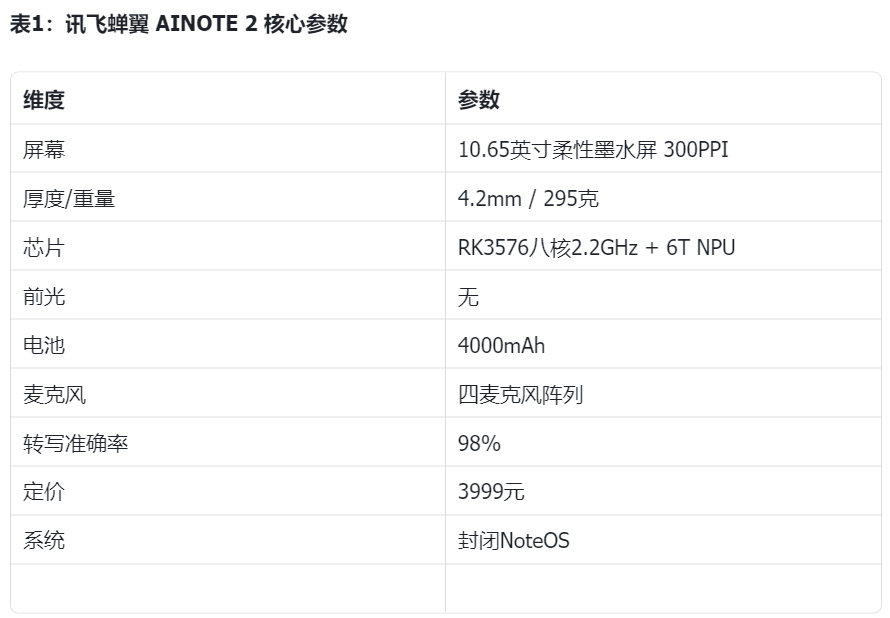
研究完我最大的感受是:他们把这款产品做得很完整,但有两个地方,和我想做的方向不完全一样——这也是我的机会。
二、硬件拆解:他们怎么解决「轻便 + AI算力」的矛盾?
芯片选型:RK3576 + 6T NPU
这块让我印象最深。
墨水屏本身不需要高算力——翻页、刷新,读文件,这些都是很低算力的任务。但AI录音转写和本地摘要生成,需要本地AI推理能力。
讯飞的解法是:在4.2mm的机身里,塞进了一颗八核芯片和独立NPU。
这个选择说明一件事:如果想让AI能力不依赖云端(离线也能用),算力是硬需求,不能省。
我之前担心小屏设备塞不下足够的算力,现在看这个方案是可行的,关键在于NPU的选型。
无前光层:显示效果的取舍
他们去掉了前光层,理由是提升光学清晰度,让屏幕更接近真实纸张。
这个选择意味着:只能在有光的地方用,晚上读不了。
对于我想做的产品来说,这是一个很重要的参考点——如果我要加夜间使用场景,就不能完全照搬这个设计。但如果我主打「白天专注阅读 + 随时记录」,去掉前光反而是个优势,不是缺陷。
电池:4000mAh
295克的机身里装4000mAh,密度控制得很激进。这也给我提了个醒——小屏要做轻不难,难的是轻的同时续航不能崩。
三、AI功能:我最关注的两个能力他们怎么做的?
录音转写:四麦克风阵列 + 98%准确率
这是我认为最有价值的功能——直接解决会议记录的场景痛点。
几个关键指标:
AI摘要:把会议内容变成结构化纪要
这个功能让我思考了很久。
他们的逻辑是:先完整录音转写,再对文本做AI提炼,生成结构化摘要。
这个流程有个好处:信息不丢失,摘要可追溯。
我之前想过直接录音生成摘要,但这种方式有个风险——如果摘要出错,没有原始内容可以回溯。两步走的方案更稳妥。
四、和我想做的产品对比:他们的方案 vs 我的想法
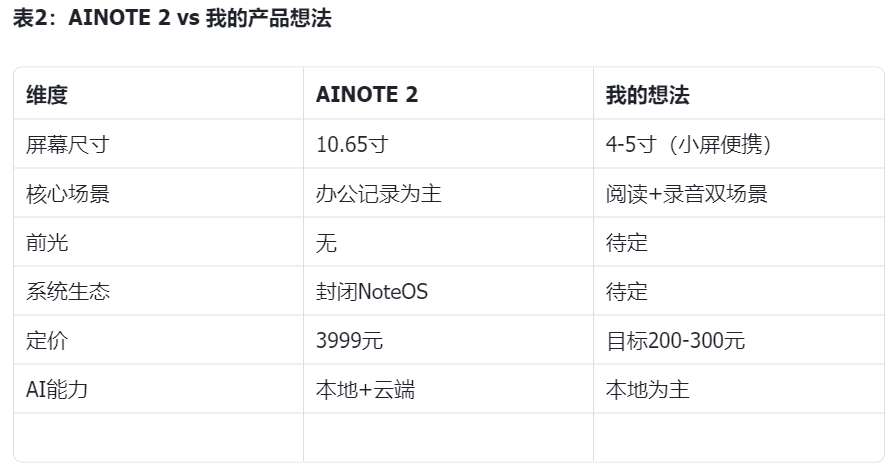
五、拆完这个产品,我自己的判断
结论一:技术上是可行的
RK3576 + 6T NPU的组合,说明在轻薄的机身里塞进本地AI算力不是问题。这坚定了我想做小屏AI设备的信心。
结论二:定价空间比我想象的大
3999元还能做到月销量第二,说明「AI+墨水屏」这个赛道用户的付费意愿是强的。我的目标是200-300元,硬件成本能不能做到,还要再仔细算。
结论三:最值得抄的作业是「录音→转写→摘要」的三段式流程
这个流程设计很清晰,用户体验路径短。我可以直接参考这个框架做自己的产品设计。
结论四:小屏是我的差异化机会
AINOTE2做的是「墨水屏上的AI办公设备」,我要做的是「能录音的小屏阅读器」。
前者解决「会议室里的问题」,后者解决「随时随地记录灵感+碎片阅读」的问题。
两个市场,两种产品。
结尾
我是叶玲,一个普通的产品经理。
最近在认真做用户调研和产品拆解——不盲干,先把市面上最好的玩家研究透。
AINOTE2是目前这个赛道最强的参照物之一。拆完它,我心里更有底了。
接下来我会继续拆解其他竞品,同时推进我的产品原型设计。有进展了在这里记录,也欢迎有类似想法的朋友一起交流。
你用过带AI功能的墨水屏设备吗?你觉得「小屏+AI录音」是刚需还是噱头?欢迎留言聊聊你的看法
Original link: https://mp.weixin.qq.com/s/uaejF4Bf3gGkJBdF9PGi-w
Lately, I've been pondering an idea: creating a compact e-ink reader with AI voice recording and meeting memo capabilities. This concept stems from my own pain points as a user — I read during fragmented moments in the day, and I needed a way to capture important meeting content on the fly. Essentially, one device solving two distinct use cases. But I'm worried that my understanding might have blind spots. So before diving in, I decided to research the market — to see if anyone else has tackled this and how they've implemented it. That's why I thoroughly reviewed the iFLYTEK Dragonfly Ink Pad AINOTE 2.
I. First, let's look at the conclusion: What level have they achieved?
4.2mm thickness × 295g weight — certified by Guinness as the world's thinnest e-ink device
10.65" screen with 300 PPI resolution
RK3576 octa-core CPU with 6T NPU (neural processing unit) for AI inference
Real-time transcription with 98% accuracy across 200+ dialects
One-tap AI-generated structured meeting memos
Searchable handwritten notes
Priced at ¥3,999 (~$560 USD) This is one of the most comprehensive "AI + e-ink" products out there.
Next, let's examine the AI functionalities I care about most — how they handle recording and transcription: Recording/Transcription: Quad-microphone array with 98% accuracy This feature is a game-changer for meeting note-taking. The setup includes:
Comparing their solution to my vision: What I can learn from them:
The choice of NPU is a solid reference.
The three-stage pipeline (record → transcribe → summarize) is an efficient user experience.
A truly small form factor (4–5 inches) for pocketability.
A significantly lower price point to reach a wider audience.
A device that fuses portable reading with impromptu note-taking — not just an office tool, but a companion for capturing thoughts throughout the day. Final thoughts: 1. The technology is ready. The RK3576+6T NPU combination proves that local AI is feasible in slim devices. 2. The market is willing to pay. The AINOTE2's price tag and sales volume show that consumers value these capabilities. 3. The recording-to-memo workflow is the best part of their design — I'll definitely be borrowing this logic. 4. My niche is in the compact, affordable segment. While the AINOTE2 solves "the problem in the conference room", I aim to solve "the problem in your pocket" — quick, private note capture between meetings. I'm Ye Ling, a regular product manager. I'm currently deep in user research and competitor analysis. The AINOTE2 is a strong benchmark, and dissecting it has given me the confidence to proceed with my own prototype. What do you think? Are AI readers a fad, or are they the future of note-taking? Let me know in the comments.
The logic behind the improvement in display effects without a front light
The areas they haven't covered are my opportunities:
Truly small-screen portable (4-5 inches instead of 10 inches or more)
更低的价格门槛
Seamless integration of portable reading and instant recording, rather than "two tasks on one large device"
V. My own judgment after analyzing this product Conclusion 1: Technologically feasible The combination of RK3576 and 6T NPU indicates that it is possible to pack local AI computing power into a thin and light frame. This reinforces my determination to create a small-screen AI device. Conclusion 2: Wider pricing range than expected Achieving the second-highest monthly sales at 3999 yuan shows that users in the "AI + E-ink" market have strong purchasing power. My target is 200-300 yuan; I still need to calculate the hardware costs. Conclusion 3: The most worth-emulating feature is the "recording → transcription → summary" three-step process This process design is clear, and the user experience path is short. I can directly reference this framework for my own product design. Conclusion 4: Small screens are my differentiating factor AINOTE2 is an "AI office device on an e-ink screen," while I want to create a "small-screen reader with recording capability." One solves "problems in the conference room," the other solves "capturing inspiration and reading on the go." Two different markets, two different products. Ending I am Ye Ling, a regular product manager. Recently, I have been conducting user research and product breakdowns seriously—not blindly rushing, but instead thoroughly studying the leading players in the market. AINOTE2 is one of the strongest benchmarks in this field. After dissecting it, I feel more confident. Next, I will continue to analyze other competitors while advancing the design of my product prototype. I will share any progress here and welcome exchange with friends who share similar ideas. Have you used an e-ink device with AI features? Do you think "small screens + AI recording" are a necessity or just a gimmick? Feel free to leave a comment to share your thoughts.