
原文链接:https://mp.weixin.qq.com/s/spbDO_fAyrt0m_qLa23xPg
在这条蓬勃发展的赛道上,科大讯飞
是在传统墨水屏阅读器之外,率先创立了智能办公本全新品类,开创性地将墨水屏应用于办公领域,把墨水屏沉浸不打扰、护眼、低功耗长待机的先天优势,与自身深耕多年的人工智能技术深度融合,不仅成功拓展了墨水屏的受众群体,更打造出与传统阅读器完全区隔的独立品类赛道。
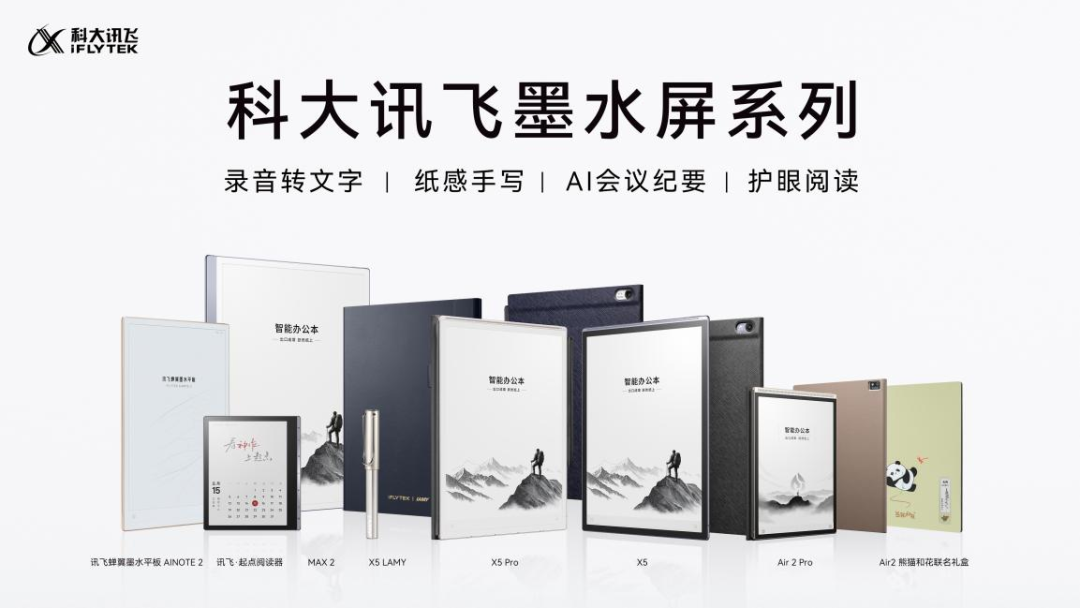
近日,讯飞发布全新品类产品——讯飞蝉翼墨水平板AINOTE2。
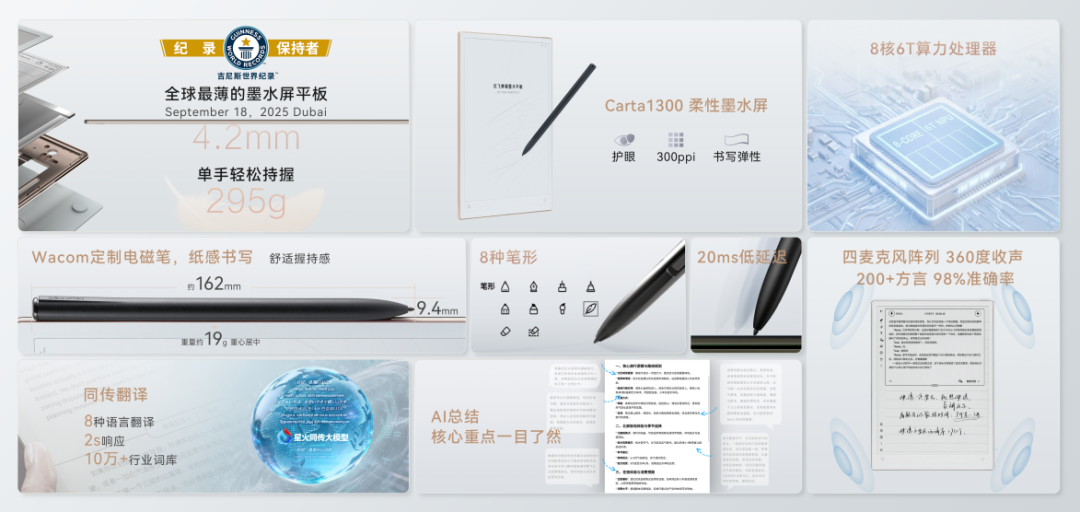
正如产品名所示,这是一款厚度仅4.2毫米的设备,被吉尼斯世界纪录认证为“全球最薄墨水屏平板”,已经在海外市场获得了认可。

回溯墨水屏设备在中国的进化路径,大致可以分为几个阶段,最初是纯阅读器模式,比如Kindle;后来是添加了手写功能的电子笔记本;又进化出了面向垂直场景的办公本和学习本。
在这个过程中,科大讯飞凭借人工智能技术的积累,以办公本为切口,找到了自己的战略锚点。2019年,讯飞发布了第一代智能办公本,切中的是“开会记录”这个高频刚需场景。
墨水屏市场上,自称“智能”的产品比比皆是,真正好用的屈指可数。问题出在AI能力的实现方式上。
绝大多数产品的AI功能是“贴上去的”,语音识别调用一个云端API,机器翻译挂一个插件,文本摘要套一个通用模型。这些功能彼此孤立,与底层系统貌合神离。用户感知到的往往是响应慢、识别不准、用不上。
讯飞蝉翼试图改变这种局面。它的AI能力在设计之初就被刻进了硬件基因,而不是作为锦上添花的附属功能。
最典型的场景是会议记录。传统流程里,参会者必须在专注听讲和埋头记录之间反复切换。注意力被切碎,关键细节在匆忙中遗漏,会后还要花数小时整理纪要。
并且,AI按键打通了系统级交互,用户可以通过物理按键一键唤起大模型问答、创建日程或打开指定应用,从想法到行动的路径被压缩到最短。

对于那些既需要深度阅读、又渴望高效记录,还希望保持专注的年轻人而言,讯飞蝉翼正在尝试提供一种“一机多用”的可能性。
如果把观察的视角拉远,讯飞在墨水屏赛道上的这一系列动作,实际上与“新质生产力”这一宏观叙事形成了内在呼应。
在这个意义上,墨水屏的竞争不应该是在性能指标上与主流平板正面交锋,而是在“注意力经济”的语境下,重新锚定自己的价值坐标。
讯飞在蝉翼墨水平板上的尝试,正是在探索这一坐标的边界。它将AI作为一种增强专注的工具,帮助用户更高效地记录、更快速地整理、更精准地回顾,从而把更多的时间和注意力留给深度思考和创造性工作。
这种AI为专注服务的产品哲学,与主流消费电子市场AI为效率服务乃至AI为黏性服务的路径形成了一种微妙的张力。
4月23日,讯飞蝉翼墨水平板AINOTE2已于京东、天猫、抖音三大电商平台开售,标准版售价3999元,键盘套装版售价4899元。
原文链接: https://mp.weixin.qq.com/s/spbDO_fAyrt0m_qLa23xPg
The global e-paper track is standing at a new starting point.
On this emerging track, iFLYTEK is the first to establish the brand-new category of intelligent office tablets beyond traditional ink screen readers. It pioneered the application of ink screens in the office domain, deeply integrating the intrinsic advantages of ink screens—immersion without disturbance, eye protection, and low-power long standby—with its years-honed artificial intelligence technology. This not only successfully expanded the audience for ink screens but also created an independent category track fully distinct from traditional readers.
Recently, iFLYTEK released a completely new product category — the iFLYTEK Swan Wing Ink Screen Tablet AINOTE2.
As the product name suggests, this is a device with a thickness of only 4.2 millimeters, certified by Guinness World Records as the “world's thinnest ink screen tablet,” which has already gained recognition in the international market.
More noteworthy than its appearance is that iFLYTEK, after establishing a strong industry foothold and achieving category creation and sustained leadership in the office tablet sector, has leveraged its deep accumulation in AI technology and ink screen hardware-software tuning to maximize the fusion of AI with ink screens. It has newly created a personal record device category for the mass consumer market, launching a category expansion toward the broader mainstream ink screen market.
Pioneering the Office Tablet Category, Building the Core Foundation of the Ink Screen Track
Looking back on the evolution of ink screen devices in China, it can be roughly divided into several stages: initially, pure reader mode (like Kindle); later, adding handwriting functionality to create electronic notebooks; and then evolving into vertical-scenario-oriented office tablets and learning tablets.
While categories continued to diversify, ink screen tablets as a “hybrid species” between tablet PCs and electronic paper long remained in an awkward state of “having a form without a core.” In form, they had a large screen, but functionally, they could neither compete head-on with ordinary tablets nor fully unleash the unique value of e-paper (“eye protection + focus”).
During this process, iFLYTEK found its strategic anchor point by leveraging its accumulation in artificial intelligence technology to enter through the office tablet niche. In 2019, iFLYTEK launched its first smart office tablet, targeting the high-frequency, must-have scenario of “meeting recording.”
At that time, most people still equated ink screens with “electronic book readers.” iFLYTEK chose a narrower path, not making readers, but office tablets. The underlying assumption was that electronic paper's low refresh rate was unsuitable for video streaming, but its large screen, eye protection, and low power consumption were naturally ideal for long-duration reading and writing. If the “recording” pain point could be solved, there was opportunity to establish a foothold among professionals.
Office tablets, as a specialized vertical category, have already established a stable market position and user reputation, serving as the core foundation of iFLYTEK's ink screen track. In 2025, office tablets accumulated 337,000 online sales units, maintaining market share leadership in the professional office e-paper market for many consecutive years. On the basis of continuously deepening office tablets and consolidating professional advantages, iFLYTEK needed to expand into the broader mass consumer market to open new growth spaces for the entire ink screen track.
Trials in the international market provided confidence. From late 2025 to early 2026, iFLYTEK's AINOTE 2 appeared at MWC Barcelona and GITEX ASIA Singapore. iFLYTEK President Wu Xiaoru revealed that AI office tablets sold 68,000 units overseas in 2025. In the high-end ink screen field, this is a noteworthy early signal. Overseas users' recognition of “paper-like writing + AI productivity” offered valuable market validation for AINOTE 2's domestic launch.
Simultaneously, iFLYTEK completed the final piece of its product matrix puzzle. At the end of 2025, iFLYTEK and E Ink jointly released the 13.3-inch electronic paper office tablet MAX2, exploring the limits of refresh efficiency and display experience in large-size devices. The reader product line was also gradually supplemented through the iFLYTEK·Qidian Reader launched in collaboration with Qidian Group. The three product lines of office tablets, readers, and ink screen tablets each play their own roles, forming a synergy covering the full range of scenarios from professional office work to mass reading, from deep creation to daily recording. The goal is clear: from a leader in niche segments to the definer of a major category.
AI不再只是插件
But category expansion alone is insufficient.
In the ink screen market, products claiming “intelligence” abound, but truly useful ones are rare. The problem lies in how AI capabilities are implemented.
Most products have AI features “pasted on”—speech recognition calls a cloud API, machine translation attaches a plugin, text summarization wraps a general-purpose model. These functions are isolated from each other and weakly integrated with the underlying system. Users often perceive slow response times, inaccurate recognition, and limited utility.
iFLYTEK Swan Wing attempts to change this. Its AI capabilities are embedded into the hardware gene from the outset, not added as a bonus feature.
The most typical scenario is meeting recording. In the traditional process, attendees must constantly switch between actively listening and frantically taking notes. Attention is fragmented, key details are missed in the rush, and hours are spent organizing minutes afterward.
iFLYTEK Swan Wing's approach is simple: one-click recording, real-time transcription, automatic AI summarization. The machine acts as a silent “second listener” during the meeting, freeing the user from the recorder role so they can fully engage in the conversation. While this sounds like a functional upgrade, it is fundamentally a restructuring of the way work is done — transitioning from “note-taker” to “note-user.”
In terms of language ability, iFLYTEK Swan Wing supports recognition of 200+ dialects without switching, and simultaneous translation in 8 languages. It also includes Tibetan and Uyghur to Chinese bilingual translation, and Cantonese to Mandarin simultaneous interpretation. These capabilities significantly widen the device's applicability in transnational meetings, cross-dialect dialogues, and intercultural collaborations.
What truly sets it apart is the deep fusion of AI with the three core competencies of writing, reading, and management. The NoteOS integrated notebook seamlessly connects audio, handwriting, and text inputs on the same interface. Sound is transcribed, handwritten notes are automatically converted to searchable text. AI summaries are not mere condensations of the audio but intelligent distillations of the transcribed text into structured minutes.
Furthermore, the AI button unlocks system-level interaction, allowing users to summon large model Q&A, create schedules, or open specific apps with a single physical button press, compressing the path from thought to action.
From an industrial perspective, this choice of a native AI route builds a moat that is difficult for competitors to cross in the short term. iFLYTEK Group's two decades of sustained investment in speech technology and AI — from speech recognition to natural language processing, from machine translation to large models — cannot be replicated merely by hardware integration. This suite of AI capabilities will continue to feed back into the office tablet, reader, and other product lines, enabling comprehensive intelligent upgrades across the matrix.
Breaking Circles: The Branding Campaign
While technical prowess is iFLYTEK's strength, breaking through market perceptions is the battle it must fight. In a market where ink screens have long been labeled as “niche, tool-like, middle-class accessories,” how does one break through category barriers to reach a broader, younger consumer base? This was the core question for iFLYTEK as it launched the Swan Wing ink screen tablet.
Signing Li Xian as the global spokesperson is highly symbolic. In the world of consumer electronics, choosing an endorser with a massive young fan base signifies an intent to move from a specialized product to a mass-market good. The logic is simple: to go mainstream, a product needs not just technical credibility but emotional resonance and cultural relevance.
The product design itself reflects this shift toward mass appeal. At 4.2 mm, it's the world's thinnest; at 295 g, it's feather-light; constructed with high-strength composite magnesium alloy and glass fiber skin, it exudes quality without bulk. These elements emphasize that this is not a drab office tool, but a lifestyle accessory—a tech artifact that inspires awe when pulled out of a bag.
Functionally, the Swan Wing is versatile enough to accommodate diverse scenarios. Its 10.65-inch, 300 PPI flexible ink screen ensures sharp reading experiences, while built-in bookstores and an open system let users choose their content freely. For handwriting, the Wacom-customized electromagnetic pen, 20 ms latency, 8 brush types, and AI-enhanced formatting make it a creator’s dream.
For young people who crave deep reading, efficient note-taking, and distraction-free use, iFLYTEK Swan Wing offers the promise of “one device for all.”
Commercially, iFLYTEK’s strategy is to leverage its strength in office tablets to expand into the larger “Ink Screen Tablet” category as a mass-market product. According to Luo Tu Technology, ink tablets have been stuck in a phase of stagnant evolution—a void iFLYTEK aims to fill. By combining AI innovation, sleek design, and celebrity endorsement, they are carving out new demand in a growing but underserved market.
The New Frontier: Attention Economy & Q-Factor Productivity
Zooming out, iFLYTEK’s moves in the ink screen space align with the broader narrative of “new quality productivity.”
New quality productivity means driving industrial transformation through technological breakthroughs. In e-paper, this doesn’t mean adding more pixels or faster chips—it means redefining the purpose of the device. Ink screens aren’t about doing more; they’re about doing less—specifically, eliminating distractions. While smartphones and tablets vie to grab every millisecond of user attention, ink screens offer a refuge: a quiet, non-invasive surface for contemplation and creation.
Thus, the battleground isn’t spec sheets—it’s the Attention Economy. iFLYTEK Swan Wing’s success hinges on whether it can convince people that their time is better spent writing, reading, and thinking on a monochrome screen than scrolling on a neon one.
With AI baked in, iFLYTEK isn’t just saving time; it’s restoring agency. Users write, speak, or draw, and the AI handles the rote work of organization. This frees mental bandwidth for higher-order tasks—precisely what Q-factor productivity is about.
In the context of the AINOTE2, the interaction between the user and the AI is bidirectional: the user provides the initial input (the raw recording) and defines the goal (specifying what to extract), while the AI processes this information to produce the final, refined output.
As of April 23, 2025, the iFLYTEK Swan Wing Ink Screen Tablet AINOTE2 is available on JD.com, Tmall, and Douyin, priced at 3,999 CNY for the standard version and 4,899 CNY with keyboard set. Whether it becomes the next Kindle or fades into obsolescence depends on whether iFLYTEK can make the case: in an age of infinite distractions, simplicity, focus, and AI-augmented calm might just be the ultimate luxury.
For iFLYTEK, the release of Canary represents both a product iteration and a strategic upgrade. From leading the niche market of office notebooks, to the cooperative expansion of the ink screen tablet category; from plugin-style AI stacking to native, deep-seated AI integration; from tools for professional scenarios to breaking through to the consumer market. These changes answer the question: "What imagination should be given to an electronic paper device in the AI era?" It is not about replacing tablets or computers, but rather offering a new choice—unaffected by push notifications, free from information overload, allowing for silent reading, thinking, and writing.
On April 23, iFLYTEK's Canary Ink Screen Tablet AINOTE2 was launched on three major e-commerce platforms: JD, Tmall, and Douyin. The standard version retails for 3999 yuan, and the keyboard set version for 4899 yuan.