
原文链接:https://mp.weixin.qq.com/s/2G-Ah8azkdk7zU0L7iqo1Q

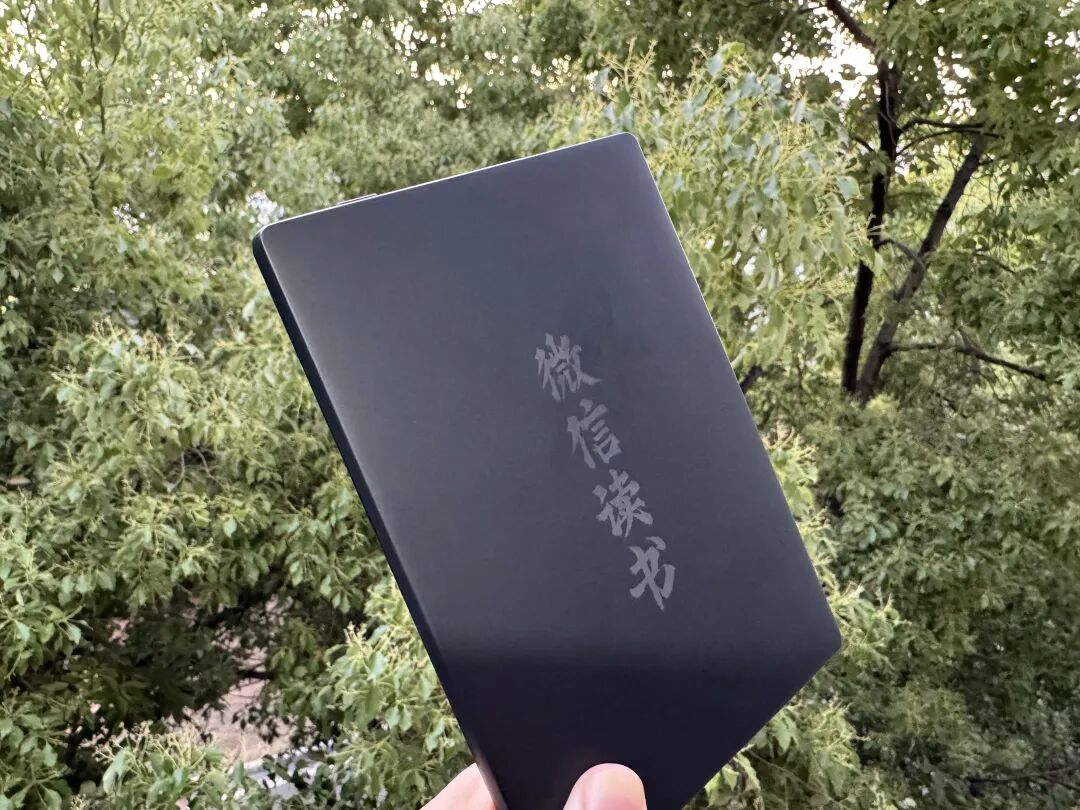
-
6英寸 -
Carta1300 -
300ppi -
高通八核2.0GHz -
2GB+32GB -
1500mAh电池 -
145克 -
6.8毫米厚
-
年初销量是4000多台,1月份还买得到; -
前段时间断货; -
后来短暂补货约341台; -
现在又断货了。

Original link: https://mp.weixin.qq.com/s/2G-Ah8azkdk7zU0L7iqo1Q
People often ask me the same question in the comments: Is there a device with hardware as closed-off and hassle-free as a Kindle, but with software that is WeRead?
My answer has always been one sentence: Yes, and it's already in its third generation. It's called the WeRead Ink Screen Reader, priced at 999 yuan.
Anyone who has used an open-system e-ink device knows that annoyance — you have to adjust the refresh mode yourself, set the ghosting removal frequency yourself, fix font aliasing yourself, and tinker with app compatibility yourself. By the time you get the settings right, half your reading enthusiasm is gone.
Why do people keep thinking about the Kindle? Not because it's powerful, but because it doesn't let you manage anything.
Turn it on and you read. Close the cover and it sleeps. This comfort of a closed system is bought by sacrificing freedom.
The third-generation WeRead Ink Screen Reader, the WeRead 3, is essentially a Chinese Kindle.
It is a completely closed device. When you turn it on, there is only WeRead.
Precisely because it serves only one app, refresh and ghosting optimization are pushed to the max — the development team doesn't need to accommodate any third-party scenarios, and all computing power and scheduling are fed to WeRead alone.
You don't need to understand specs. You can start reading right away. That is the strength of a closed system.
The customer base is cut with extreme precision.
The third-generation WeRead Ink Screen Reader and the Boox Poke6 share the same build quality, with nearly identical hardware:
6 inches
Carta 1300
300 ppi
Qualcomm octa-core 2.0 GHz
2GB + 32GB
1500mAh battery
145 grams
6.8mm thick
The Poke6 launched at 1,099 yuan, while the WeRead Ink Screen Reader third generation is 999 yuan.
But the product philosophies of the two are completely opposite:
Poke6: Open Android 11, can install any app, works across multiple platforms.
WeRead Ink Screen Reader third generation: Closed and customized. When you turn it on, there is only WeRead. There is no fallback.
Most people would instinctively choose the Poke6, for a simple reason — what if one day I don't want to use WeRead anymore?
Those who directly order the WeRead third generation never planned to leave themselves an escape route from the start.
They only read on WeRead, so they only need a device that can only read WeRead.
The need is pure, the decision is decisive, and once it arrives, it almost never ends up on the second-hand market.
So you rarely see it on second-hand platforms. If you don't believe it, go search right now. This e-ink device has one of the lowest turnover rates of any model.
This is the market shape that only appears after segmenting the audience to the extreme. My "usage scenario" theory is once again proven.
It has kept its original price amid the wave of price increases.
Last year, I already predicted that e-ink readers would see a price increase in 2026: I could already smell that in 2026, e-ink e-reader prices would rise across the board (with purchase recommendations).
The logic is simple: memory chips are rising, main control chips are rising, and the whole-device BOM cost is rising.
But the price of the WeRead third generation has never moved — still 999 yuan. (In this wave of price increases, it is honestly a good deal, even a bit under-priced.)
Three e-ink readers priced "too generously."
The first generation was 1,499 yuan and used the Poke3 mold; the second generation was 1,999 yuan with a custom 7.8-inch design; the third generation cut the price directly to 999 yuan and reused the Poke6 — across three generations, Tencent pushed the price down and brought the hardware platform up.
This is a rare reverse move in today's e-ink market.
Even more critical is that its purchase channel is absurdly hidden. You can't find it on JD.com, Tmall, or Pinduoduo. The only channel is the WeChat store inside the WeRead app.
I have written three related articles before, with over ten thousand total reads, and the comments still have many readers learning for the first time that WeRead itself has released an e-reader.
The supply rhythm also confirms this:
At the beginning of the year, sales were over 4,000 units, and it was still available in January.
It went out of stock a while ago.
Later, there was a brief restock of about 341 units.
Now it is out of stock again.
The experience is smoother than third-party options.
I can say it directly: The WeRead on the WeRead third generation is smoother than the WeRead I have used on any other e-ink device.
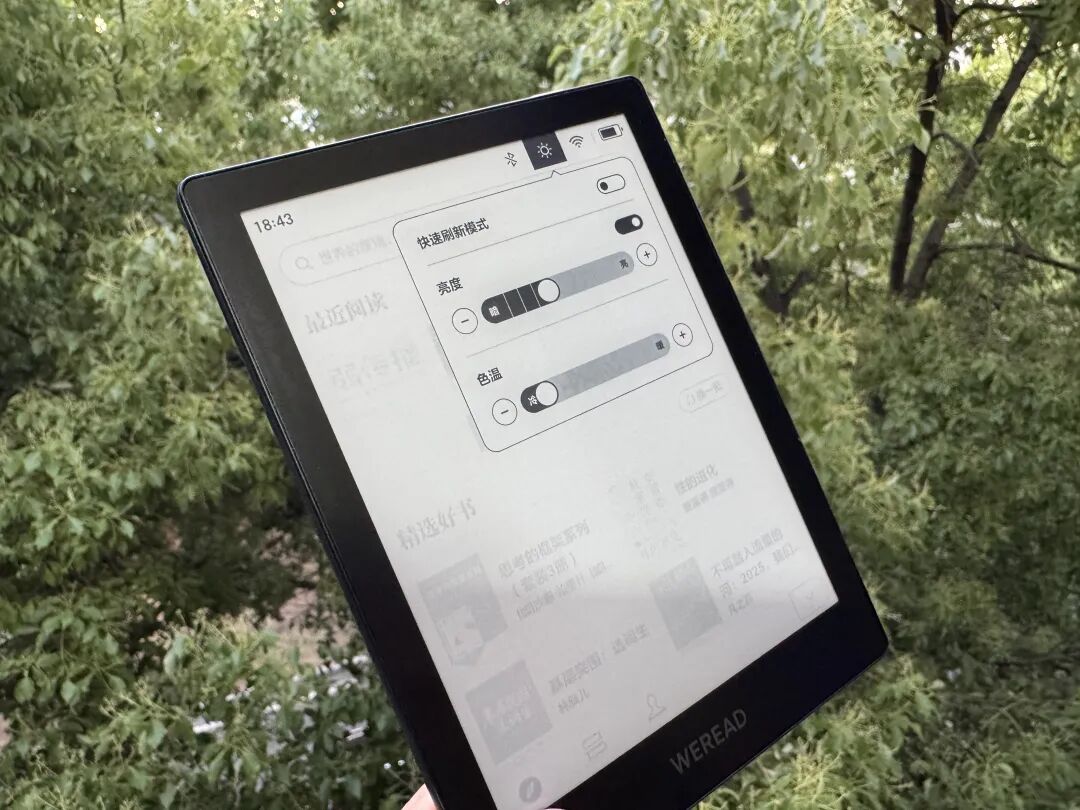
On the whole machine, the front light is the only place you can manually adjust. Everywhere else, you are not given permission to change anything.
A closed system running on open-system hardware specs is inherently a dimensionality reduction attack.
Add WeChat's native ecosystem integration — one-tap floating window for official account articles, instant syncing of favorites, cross-device transfer of reading notes — this smoothness cannot be replicated by installing the WeRead app on a third-party device.
If you like a white screen background, then you are in luck. As for how white it is, look at the photos yourself. These photos were taken straight from an iPhone's original camera.
The naked-eye impression is even whiter than the photos. I even think it can compete with the white of screens with the cover glass layer removed.
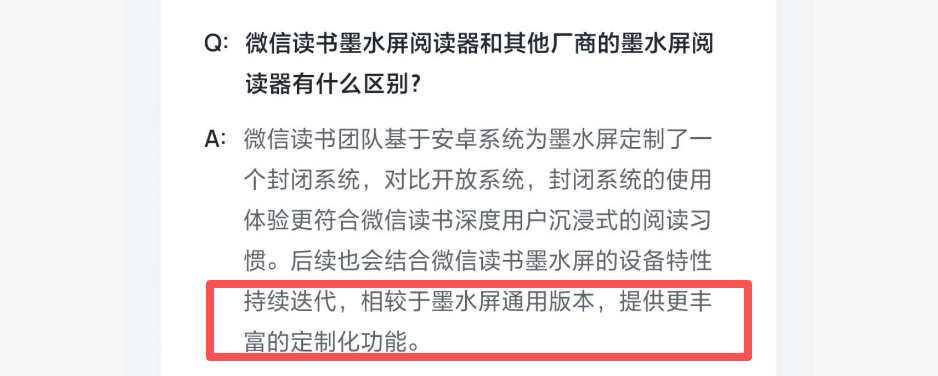
In the official introduction from the WeRead team, there is a line: Compared with the universal e-ink version, it offers richer customized features.
In other words: All new features run first on their own hardware, and only after maturing are they released to the universal version. People who buy it will always get the next-generation experience ahead of everyone else.
Tencent knows its boundaries very well — it is good at software and does not touch hardware, so it outsources manufacturing to Boox and focuses on the system itself.
This restraint is precisely what made the product stand firm.
Being closed is not being backward; it is another posture for taking one thing to the extreme.