
从2024年10月份(大四上学期)至今,我手里的墨水屏经历了一轮一轮的“进进出出”,但留下来的数量还是在不断增加。
目前,我手头已经有8台了,从6寸的便携款到10.3寸的“PDF阅读器”,品牌涵盖了Kindle、Kobo、Tolino和博阅。

但是体验的墨水屏多了,我发现这些机器其实都大差不差,主要就是屏幕大小、显示效果、背光、是否开放、手写这些方面。而且,受限于墨水屏刷新率的物理瓶颈,性能在短时间内也很难有什么大的进步。
虽然我使用过的墨水屏都是好几年前的老机子,甚至是十几年前的“老古董”,但我也经常关注不同品牌发布的新品,以及b站上相关的介绍、体验等视频。整体感觉就是——墨水屏并没有真正的代差,完全没必要追求新款。
如果你打算入手一台墨水屏,与其盯着参数,不如先看看自己的实际需求。
如果你有找书能力,习惯通过电子书分享群、z-library、Anna’s Archive等渠道获取电子书资源,那么可以直接选择Kindle或者Kobo,显示效果和续航都很棒。

如果你需要手写,建议直接选择国产的大屏电纸书,它们在手写优化和应用支持上做得更好。
如果你需要使用第三方app,就选择开放系统的国产墨水屏,功能会更完善一些。
关于墨水屏的尺寸选择,主要看你的阅读场景。
对于6寸以及手机形态的墨水屏,优势就是便携,更适合在地铁、通勤途中使用。此外,也有一些大佬根据开发板做的阅读器,例如M5 paper S3。不过我个人对手机形态不是很感冒,感觉“竖长条”的屏幕没有沉浸感。
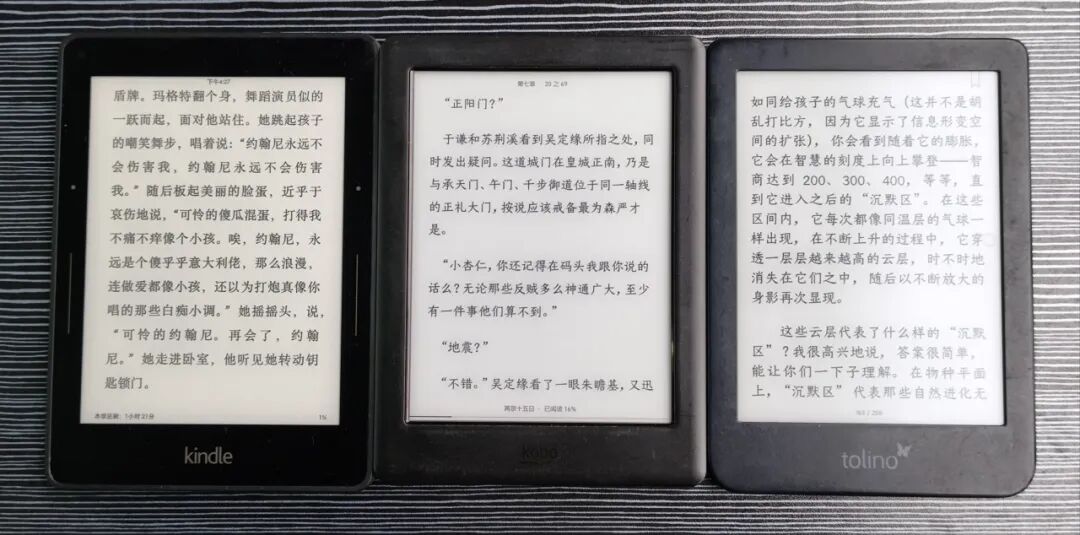
对于6.8寸/7寸的墨水屏,则更适合在家里面,或者工位使用,一方面方便单手拿,另一方面能显示更多内容,而且能够看一些简单的漫画。
对于10寸以上的墨水屏,使用场景更多是深度阅读、PDF批注、漫画爱好者。再配备支架和手写笔,就是一个移动的书房。
关于墨水屏的数量,我的评价是够用就行,千万不要上头!
根据不同的使用场景,买2-3个不同尺寸的墨水屏就足够了,而且不一定选择全新的,二手更有性价比。
同时,买过之后,就不要再刷关于墨水屏的内容了。
很多人(包括我)在购买后会陷入一种恶性循环:刷帖子——被种草——逛咸鱼或淘宝——体验新机——再次刷帖。
在这个过程中,我们原本的初衷——阅读,反而被抛在了脑后。
最近这段时间,我经常逛咸鱼,没事就刷一刷,看看有没有好玩的墨水屏,其实主要是看看有没有捡漏的,哈哈哈。
不过,目前的情况是:既没什么新奇的阅读器,也没有可以捡漏的机会;而且,普通卖家的东西很难卖出去,主要是平台不分流量,挂的链接每天只有二三十的浏览量。
此外,手头的阅读器多了,每次想看书的时候,我还要先纠结“翻哪个墨水屏的牌子”。这对于有选择困难症的我来说,无疑会白白浪费时间和精力。
之后,我会陆续出掉一些吃灰的机器,将库存尽量缩减到5台以内。我想把更多的精力还给书籍本身,而不是消磨在无意义的刷帖和换机上。
总而言之,买墨水屏,满足自己的需求即可。不用追求新款,也不用迷信体验,重要的永远不是那块屏幕,而是屏幕背后的文字,以及阅读时的那份宁静。
From October 2024 (first semester of senior year) to now, the e-ink devices in my hands have gone through round after round of "comings and goings," but the number I kept has kept growing.
Currently, I already have 8 devices, from portable 6-inch models to 10.3-inch "PDF readers," covering the brands Kindle, Kobo, Tolino, and Boyue.
But after experiencing so many e-ink readers, I've found that these devices are actually mostly the same—the main differences are screen size, display quality, frontlight, whether the system is open, and handwriting support. Moreover, limited by the physical bottleneck of e-ink refresh rates, performance is unlikely to improve dramatically in the short term.
Although the e-ink readers I've used are all old models from several years ago—some are even "ancient relics" from over a decade ago—I also often keep an eye on new releases from different brands, as well as related introduction and review videos on Bilibili. My overall impression is that e-ink readers have no true generational gap, and there's absolutely no need to chase new models.
If you're planning to get an e-ink reader, instead of staring at the specs, you should first look at your actual needs.
If you have a knack for finding books and are used to getting e-book resources through e-book sharing groups, Z-Library, Anna's Archive, and other channels, then you can directly choose a Kindle or Kobo—their display quality and battery life are excellent.
If you need handwriting support, I'd suggest directly choosing a domestic large-screen e-reader, as they do better in handwriting optimization and app support.
If you need to use third-party apps, then choose a domestic e-ink reader with an open system, as its features will be more complete.
As for choosing the size of an e-ink reader, it mainly depends on your reading scenarios.
For 6-inch and phone-form e-ink readers, their advantage is portability, making them better suited for use on the subway or during commutes. In addition, some experts have built readers based on development boards, such as the M5 Paper S3. However, I personally am not a fan of the phone form factor—I feel that the "tall, narrow strip" screen lacks immersion.
For 6.8-inch and 7-inch e-ink readers, they are more suitable for use at home or at your workstation. On the one hand, they're easy to hold with one hand; on the other hand, they can display more content and can even handle some simple comics.
For e-ink readers above 10 inches, the use cases are more about deep reading, PDF annotation, and comic enthusiasts. Paired with a stand and a stylus, they become a mobile study.
As for the number of e-ink readers, my take is that having enough is fine—don't get carried away!
Based on different usage scenarios, buying 2-3 e-ink readers of different sizes is enough, and you don't necessarily have to choose brand-new ones; second-hand ones offer better value for money.
At the same time, after you make the purchase, stop browsing content about e-ink readers.
Many people (including me) fall into a vicious cycle after buying: scrolling through posts → getting tempted → browsing Xianyu or Taobao → trying out new devices → scrolling through posts again.
In this process, our original intention—reading—ends up being left behind.
Recently, I've been browsing Xianyu a lot, scrolling through it whenever I have free time to see if there are any fun e-ink readers, mainly to see if I can snag a bargain, haha.
However, the current situation is: there are neither any novel readers nor any opportunities to snag a bargain. Also, ordinary sellers can hardly move their items, mainly because the platform doesn't allocate much traffic—listings only get about twenty to thirty views per day.
Moreover, with so many readers on hand, every time I want to read, I first have to agonize over "which e-reader should be favored tonight." For someone like me with decision paralysis, this undoubtedly wastes time and energy.
Going forward, I'll gradually sell off some of the dust-collecting devices and try to trim my collection to no more than five. I want to give more of my energy back to the books themselves, rather than burning it on pointless scrolling and device swapping.
In short, when buying an e-ink reader, just make sure it meets your needs. There's no need to chase new models or blindly believe in the "experience." What matters is never the screen itself, but the words behind it, and the tranquility you feel while reading.
Original link: https://mp.weixin.qq.com/s/BBFXd-D2gKrCPDRFM4WUgg