

无论是考试卡壳无法突破,还是面临选择陷入迷茫,核心问题都在于——只看到了问题的单一维度,而主题阅读,正是帮你跳出单一视角、找到核心答案的关键方法。
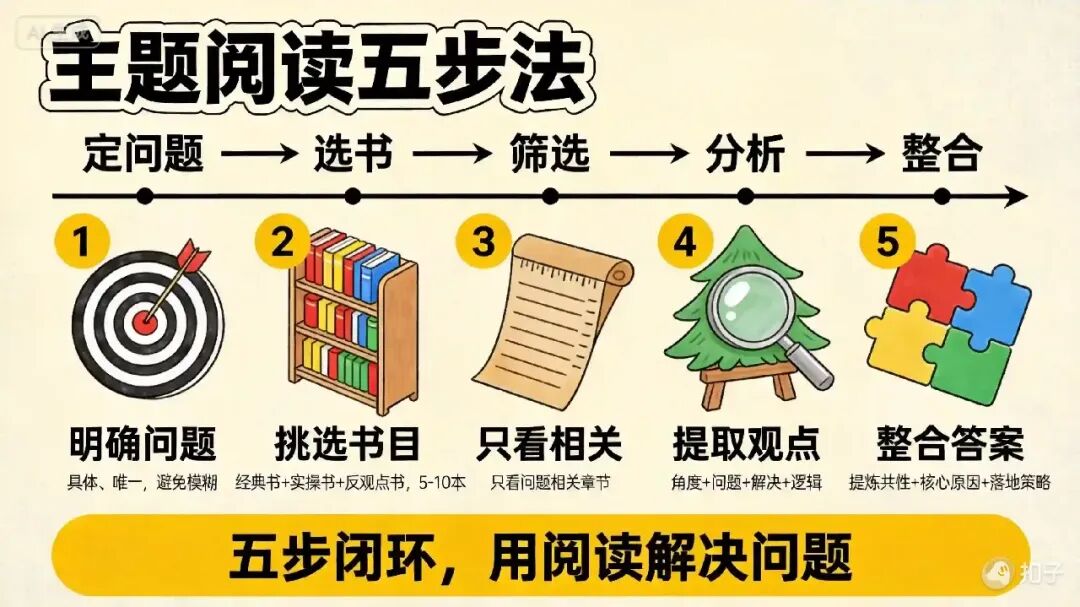
2、多种类的挑选书目,可以从经典书、实操书、反面观点书几个方面去挑选,一般5-10本同主题书就可以了;经典书侧重原理,实操书方便落地,反观点书避免思维局限;
3、只看与问题相关的章节,主题阅读只看问题相关的内容,不在不相关的细节上浪费时间;
4、内容重点看“观点+结构”:作者是从什么角度看的?(如心理学、经济学、生物学、物理学等)作者认为问题是什么?他是如何解决的?逻辑合理吗?
5、整合出自己的答案:
将不同作者结论整合到一起,可以从以下问题展开:
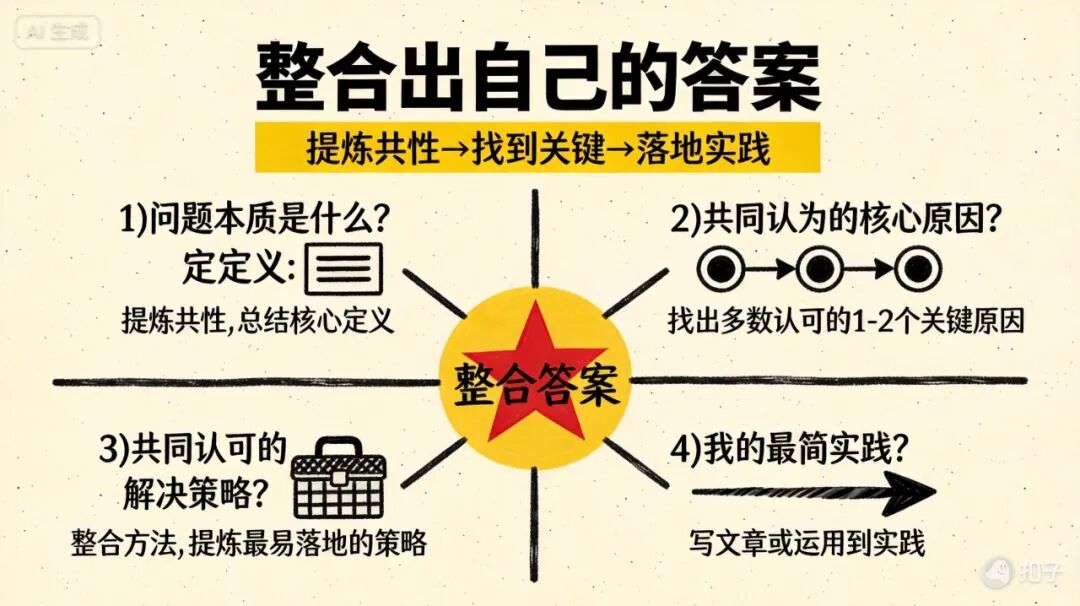
1)问题的本质是什么?
提炼所有作者观点的共性,总结最核心的定义;
2)共同认为的核心原因是什么?
找出多数作者认可的1-2个关键原因;
3)共同认可的解决策略是什么?
整合不同作者的方法,提炼最易落地的1-2个核心策略;
4)我的最简单的实践是什么?
实践可以是将所学梳理成一篇文章,也可以是将知识运用到实践中去。
最后一条才是改变的关键,所有的知识都是要经过实践检验的,这也是主题阅读的延伸。
三、总结
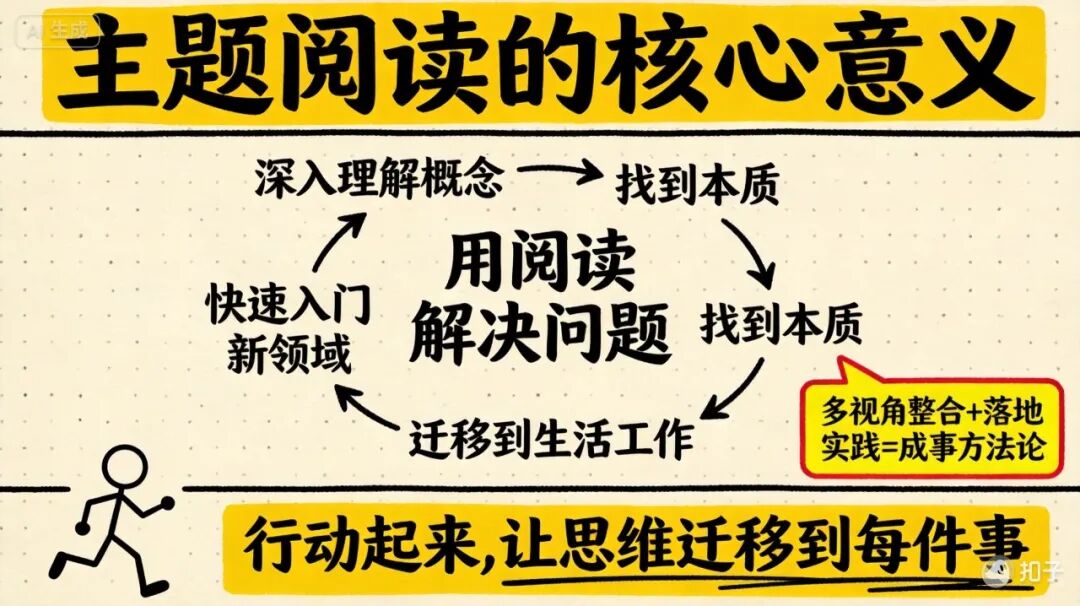
主题阅读的核心,从来不是‘读多少书’,而是‘用阅读解决问题’——当你用主题阅读的方法深入理解一个领域、解决一个难题,这种‘多视角整合、落地实践’的思维,会迁移到你生活、工作的每一件事上,这就是主题阅读作为‘成事方法论’的核心意义。行动起来,将这个方法应用到你的生活和工作中,你一定会受益良多。
你在平时阅读时困惑有哪些?可以在评论区留言告诉我。关注我,我将持续分享个人成长相关内容。
PS:为了让大家快速践行主题阅读,我整理了一份可直接填写的模板,模板对应前文的实操步骤,每一项都可对照逐步填写,帮你快速整合观点、形成自己的解决方案。
|
序号 |
阅读核心模块 |
填写内容(按个人阅读逻辑补充) |
|
1 |
我要解决的核心问题(唯一) |
|
|
2 |
作者 / 书籍 |
|
|
3 |
作者的角度(从哪个维度看?) (可选维度:心理、认知、生理、社会、道德、经济、哲学等) |
|
|
4 |
作者认为问题本质是什么(他的定义) |
|
|
5 |
作者的解决方案 / 核心观点 |
|
|
6 |
作者的论证逻辑(如何推导?) 前提:__________ 推理:__________ 结论:__________ |
|
|
7 |
逻辑是否合理、是否自洽? |
The essence of thematic reading is not "reading many books," but "using many books" to solve a problem.
Have you ever intensely studied professional books for career advancement, yet failed to break through your capability bottleneck because the knowledge points were scattered and couldn't be connected? Or, when facing career choices (changing fields, switching jobs, project decisions), you sought advice from elders, colleagues, and friends, only to receive conflicting suggestions that left you more confused and unable to make a decision?
Whether you're stuck on an exam or lost in a difficult choice, the core issue is the same — you're only seeing the problem from a single dimension. Thematic reading is the key method to help you break out of that single perspective and find the core answer.
If you are currently experiencing or about to face such situations, please read this through carefully and practice the methods described. You will gain two core skills: 1. How to deeply and comprehensively understand a concept and find its essence; 2. A learning method to quickly get started in a new field.
Thematic reading builds on the foundations of inspective reading and analytical reading. It is recommended to bookmark this article and refer to it repeatedly while practicing. If you'd like to learn more about the first two reading methods, please check my previous articles. Below, I will discuss why thematic reading matters and how to conduct it. At the end of the article, I've included a thematic reading template you can use directly.
I. Why Thematic Reading?
First, what is thematic reading?
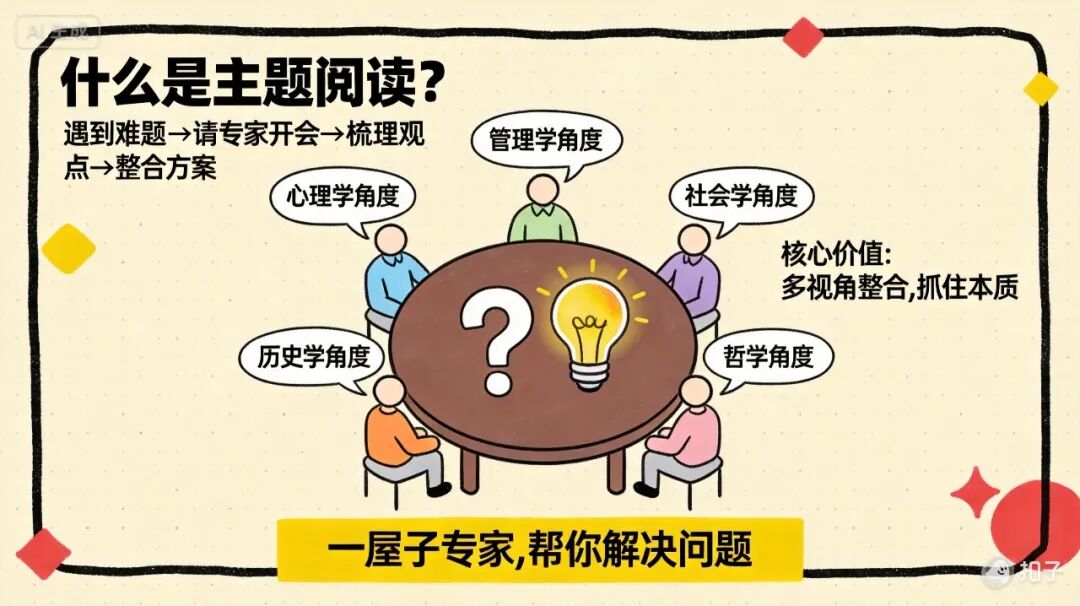
Imagine you've encountered a difficult problem (a theme) and convened a room full of experts (different books). Each expert shares their opinion (the conclusions of each book); you then analyze and synthesize the conclusions and reasoning of these experts (different books), ultimately forming your own solution. That process is thematic reading.
This example clearly illustrates that a single perspective can never fully grasp the essence of things. The core value of thematic reading lies in integrating multiple perspectives to help us抓住 the key point and make sound decisions. That is precisely why we need thematic reading.
II. How to Conduct Thematic Reading?
Thematic reading involves three stages—selecting books, focusing on key points, and synthesizing—and can be carried out following the five steps below:
1. The core of thematic reading is solving problems. Before selecting books (resources), you must clarify what problem you're trying to solve. The core question should be specific and singular, avoiding ambiguity.
For example, instead of saying "how to improve reading efficiency," say "how to master the core methods of workplace communication within 3 weeks through thematic reading."
2. Select books of various types, including classics, practical guides, and books presenting opposing viewpoints. Generally, 5–10 books on the same theme are sufficient. Classics emphasize principles, practical books facilitate implementation, and opposing-viewpoint books prevent cognitive bias.
3. Only read chapters relevant to your problem. Thematic reading focuses solely on content related to the question — don't waste time on irrelevant details.
4. Focus on "perspective + structure": From what angle does the author approach the issue? (e.g., psychology, economics, biology, physics, etc.) What does the author consider the problem to be? How do they propose to solve it? Is the logic sound?
5. Integrate your own answer:
Combine the conclusions from different authors, addressing the following questions:
1) What is the essence of the problem?
Extract the commonalities across all authors' viewpoints and summarize the most core definition.
2) What do they collectively identify as the root cause?
Identify the one to two key causes most authors agree on.
3) What is the commonly recognized solution strategy?
Integrate methods from different authors and distill the one to two most actionable core strategies.
4) What is my simplest practical step?
Practice can mean organizing what you've learned into an article, or applying the knowledge in real-world situations.
The final step is what truly drives change. All knowledge must be tested through practice — this is the extension of thematic reading.
III. Summary
The core of thematic reading has never been about "how many books you've read," but about "using reading to solve problems." When you use thematic reading to deeply understand a field and solve a challenge, the mindset of "integrating multiple perspectives and putting them into practice" will transfer to every aspect of your life and work. This is the core significance of thematic reading as a methodology for getting things done. Take action and apply this method to your life and work — you will benefit greatly.
What困惑 do you have about your reading habits? Leave a comment below. Follow me, and I'll continue sharing content on personal growth.
PS: To help everyone quickly put thematic reading into practice, I've compiled a fill-in template corresponding to the practical steps above. Each item can be filled in step by step, helping you rapidly integrate viewpoints and form your own solution.
Serial Number
Core Reading Module
Content to Fill In (Supplement according to your personal reading logic)
1
The core problem I want to solve (singular)
2
Author / Book
3
Author's perspective (from which dimension?) (Optional dimensions: psychological, cognitive, physiological, social, moral, economic, philosophical, etc.)
4
What the author considers the essence of the problem (their definition)
5
The author's solution / core viewpoint
6
The author's reasoning logic (how is it derived?) Premise: __________ Reasoning: __________ Conclusion: __________
7
Is the logic reasonable and self-consistent?
Original link: https://mp.weixin.qq.com/s/RIcBsuOn816XIPBNcMCtlQ