
一提BOM,第一反应就是“物料清单”。 但真到了项目现场,同样是BOM,研发、工艺、制造说的不是一回事。
研发觉得:结构已经清楚了,BOM不是早就发了吗?
工艺觉得:你给的是设计结构,不是我能直接编工艺的BOM。
制造觉得:系统里有料,但现场还是装不顺,说明生产用的BOM根本没理顺。
问题就出在这里。BOM不是一张表,而是同一个产品在不同阶段、不同业务视角下的结构表达。
所以,一个产品会有三种常见BOM:EBOM、PBOM、MBOM。
一、一个产品,为什么会有三种BOM?
原因很简单:同一个产品,在不同部门眼里,关注点不一样。
-
研发关注的是产品怎么设计、由哪些零部件组成、结构关系是什么。
-
工艺关注的是产品怎么加工、怎么装配、工序怎么拆、先后顺序怎么排。
-
制造关注的是现场到底拿什么料、在哪个工位装、按什么版本执行。
也就是说,产品没变,但看它的角度变了。
如果只保留一套BOM,通常就会出现两个问题:
-
研发能看懂,现场用不了 -
系统里有数据,但流程跑不动
所以,三种BOM不是重复建设,而是产品数据从设计走向制造必须经过的三个层次。


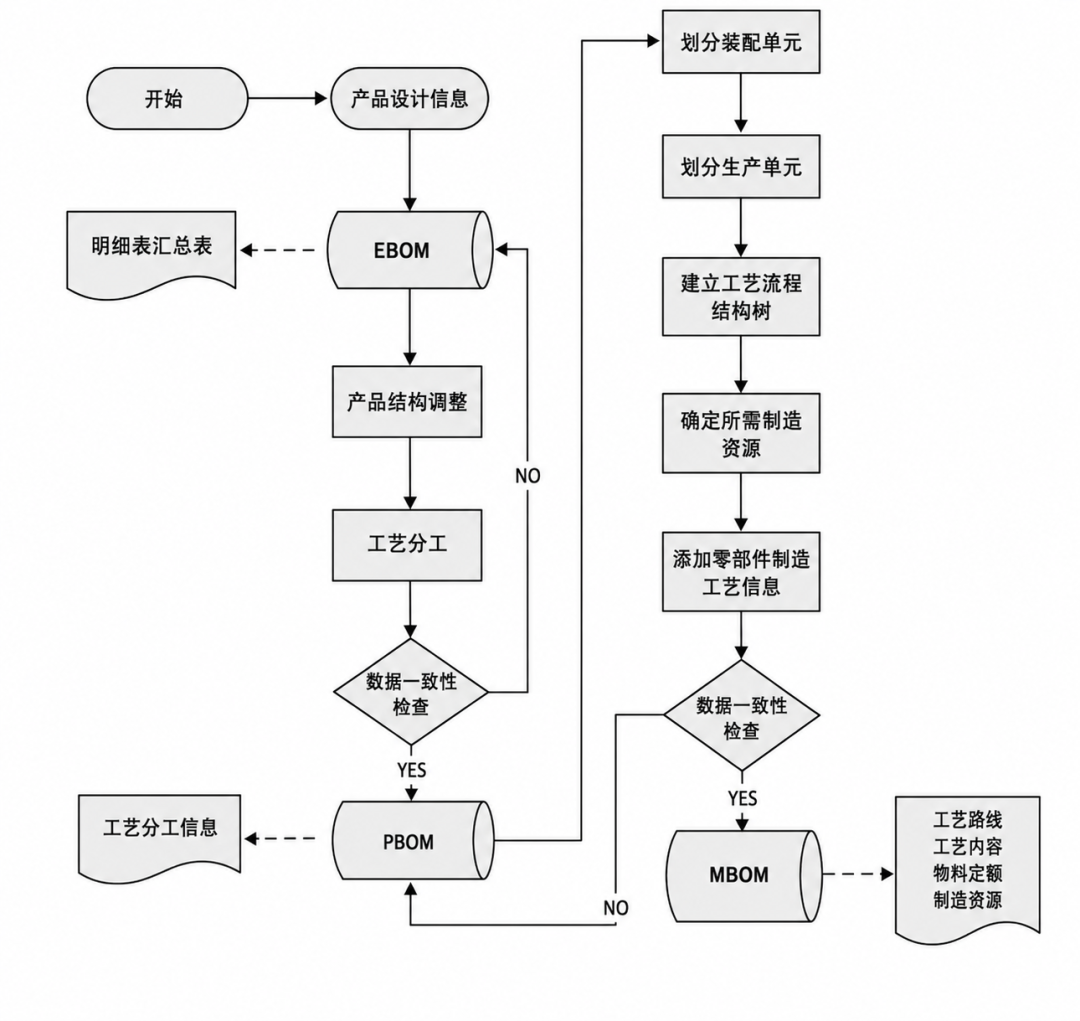
二、EBOM、PBOM、MBOM分别是什么?
1. EBOM:研发视角的BOM
EBOM,全称是 Engineering BOM,一般叫设计BOM。
它解决的是一个问题:这个产品从设计上由哪些零部件组成,它们之间是什么结构关系。
EBOM通常由研发建立,重点是:
-
产品层级结构 -
图号、料号、版本 -
设计件与子件关系 -
数量关系 -
模块划分
所以,EBOM本质上是设计结构树。 它非常重要,因为它是产品定义的起点。
但EBOM有一个明显局限:它是按设计逻辑组织的,不是按制造逻辑组织的。
研发看EBOM没问题,不代表工艺和生产能直接拿来用。
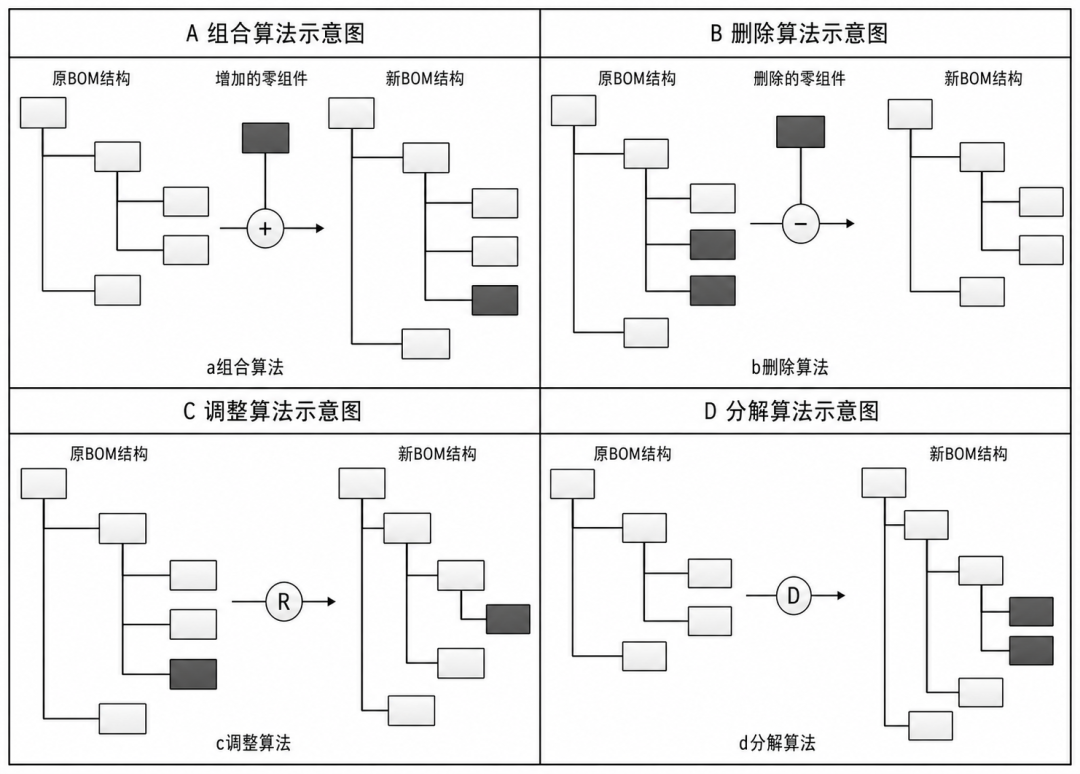
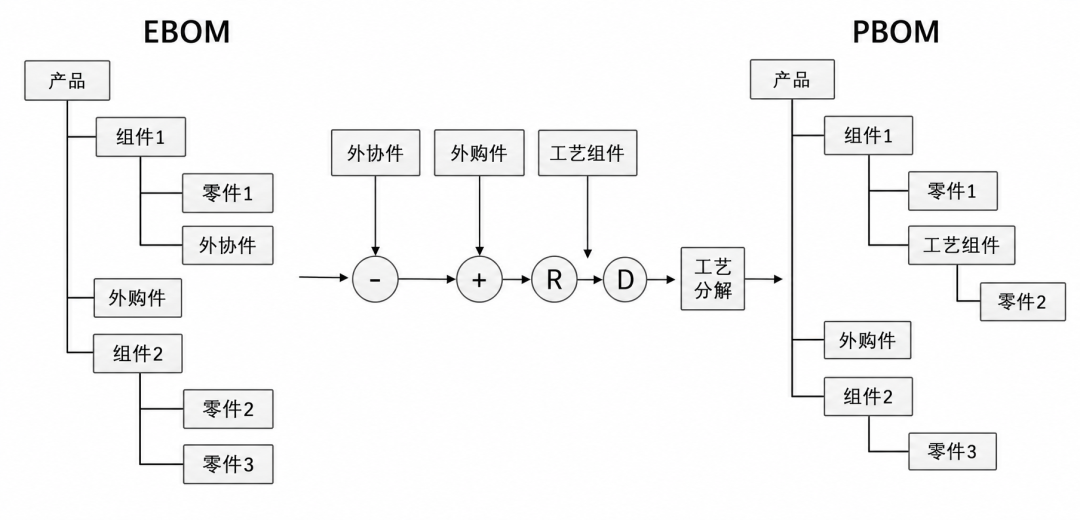
2. PBOM:工艺视角的BOM
PBOM,一般理解为 Process BOM,也就是工艺BOM。
它解决的是另一个问题:这个产品该怎么做、怎么装、怎么按过程展开。
PBOM不是简单复制EBOM,而是把设计结构转换成工艺过程能理解的结构。它更关注:
-
工序拆分 -
装配顺序 -
半成品、中间件 -
工艺路线 -
辅料、胶、焊材、紧固件等过程用料 -
哪些零件在哪一步进入
也就是说,PBOM站在工艺角度,不再只看“产品由什么组成”,而是开始看“产品怎么一步一步做出来”。
所以,PBOM其实是从设计到制造之间的一次“翻译”。
3. MBOM:制造视角的BOM
MBOM,全称 Manufacturing BOM,一般叫制造BOM。
它解决的是最现实的问题:现场到底拿什么料、在哪个工位、按什么版本、什么顺序去生产。
MBOM最接近生产执行,通常会体现:
-
工位投料关系 -
生产版本 -
替代料关系 -
领料方式 -
齐套需求 -
线边配送逻辑 -
实际装配执行结构
如果说EBOM是“设计看得懂”,PBOM是“工艺能展开”,那MBOM就是“现场真能干”。

三、这三种BOM到底差在哪?
可以直接看这张表:
| 类型 | 中文名称 | 核心关注点 | 主要使用部门 |
|---|---|---|---|
| EBOM | 设计BOM | 产品设计结构、零部件组成 | 研发 |
| PBOM | 工艺BOM | 工艺路线、工序拆分、装配过程 | 工艺 |
| MBOM | 制造BOM | 生产执行、投料、工位、版本管理 | 制造、计划、采购、仓库 |
说得更直接一点:
-
EBOM回答:设计上是什么 -
PBOM回答:过程上怎么做 -
MBOM回答:现场上怎么干
这就是三者最本质的区别。
四、很多公司为什么总在BOM上出问题?
因为很多企业只重视EBOM,不重视后面的承接。
研发觉得图纸发了、EBOM建了,输出就完成了。 但对后端来说,真正能支撑生产的,不是单纯的设计结构,而是经过工艺转换和制造展开之后的数据。
一旦这个转换过程没做好,就会出现很多典型问题:
-
图纸更新了,现场还是老版本 -
系统里有料号,工位却不知道怎么投 -
设计上是一个总成,制造上必须拆成多个中间件 -
辅料、紧固件、替代料没有进正确BOM -
采购按旧版本买,现场按新版本装
这些问题表面看是数据不一致,实际上本质是:设计、工艺、制造三套语言没有打通。
五、真正要管的,不是三张表,而是三者之间的承接
很多人以为BOM管理,就是把三套BOM都建出来。其实这只完成了一半。
更重要的是三件事:
1. 边界要清楚
研发管EBOM,工艺管PBOM,制造主导MBOM,但责任不能模糊。
2. 转换规则要清楚
哪些设计结构直接继承,哪些需要重组,哪些要新增中间件和过程物料,都要有规则。
3. 变更要同步
设计变更如果只改了EBOM,没有同步到PBOM和MBOM,现场最终还是会乱。
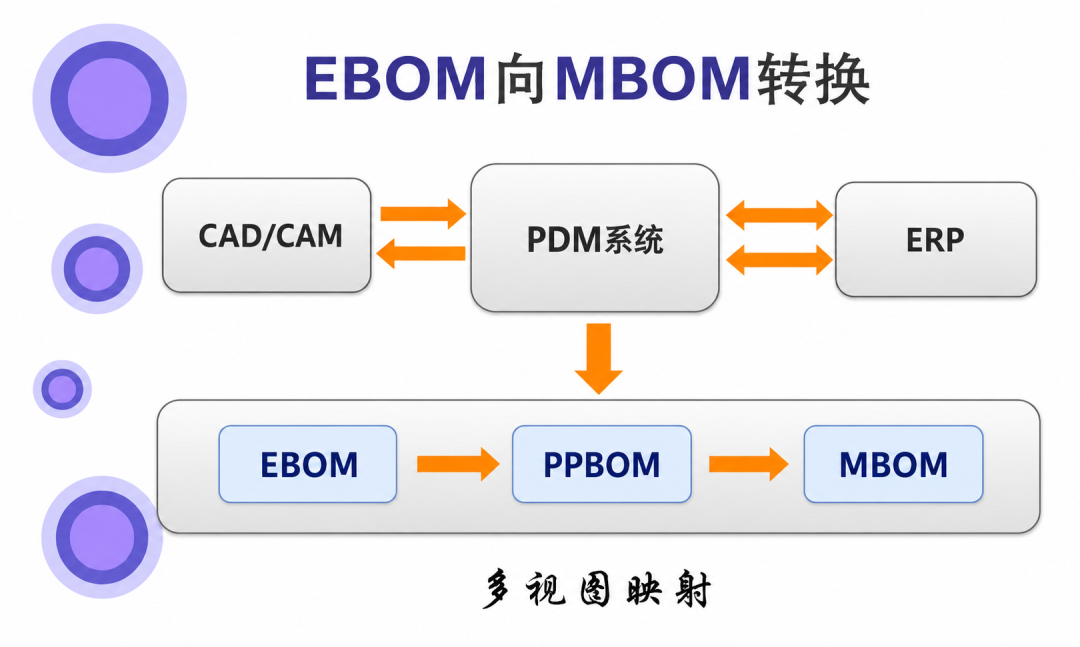
所以,BOM管理真正难的,从来不是“有没有BOM”,而是设计数据能不能顺利走到工艺,再稳定落到制造。
When BOM is mentioned, the first reaction is “bill of materials.” But at the actual project site, although it is the same BOM, R&D, process engineering, and manufacturing are not talking about the same thing.
R&D thinks: The structure is already clear; wasn’t the BOM sent out long ago?
Process engineering thinks: What you gave is a design structure, not a BOM I can directly use to compile the process.
Manufacturing thinks: The materials are in the system, but assembly still doesn’t go smoothly on the shop floor, which shows the BOM for production has never been sorted out.
The problem lies right here. A BOM is not a single table; it is the structural expression of the same product at different stages and from different business perspectives.
Therefore, one product has three common BOMs: EBOM, PBOM, and MBOM.
I. Why does one product have three BOMs?
The reason is simple: the same product is viewed differently by different departments, with different focuses.
R&D focuses on how the product is designed, which components it consists of, and what the structural relationships are.
Process engineering focuses on how the product is processed, how it is assembled, how the operations are broken down, and how the sequence is arranged.
Manufacturing focuses on exactly what materials are taken on the shop floor, at which workstation they are installed, and which version is used for execution.
In other words, the product has not changed, but the perspective on it has changed.
If only one set of BOMs is kept, two problems usually arise:
R&D can understand it, but the shop floor cannot use it.
The system has data, but the process cannot run.
Therefore, the three BOMs are not redundant construction; they are the three levels that product data must pass through from design to manufacturing.
II. What are EBOM, PBOM, and MBOM respectively?
1. EBOM: the BOM from the R&D perspective
EBOM, whose full name is Engineering BOM, is generally called the Design BOM.
It solves one question: from a design standpoint, which components make up this product, and what are the structural relationships among them?
EBOM is usually established by R&D, with the focus on:
Product hierarchical structure
Drawing number, part number, and version
Relationships between design items and sub-items
Quantity relationships
Module division
Therefore, EBOM is essentially a design structure tree. It is very important because it is the starting point of product definition.
But EBOM has an obvious limitation: it is organized according to design logic, not manufacturing logic.
EBOM is fine for R&D, but it doesn't mean processes and production can use it directly.
2. PBOM: BOM from a process perspective
PBOM, generally understood as Process BOM, is the Process Bill of Materials.
It solves a different problem: how this product should be made, assembled, and expanded by process.
PBOM doesn't simply copy EBOM; it converts the design structure into a structure that the process can understand. It focuses more on:
Process division
Assembly sequence
Semi-finished products and intermediate components
Process routes
Auxiliary materials, adhesives, welding materials, fasteners, etc. used during the process
Which parts enter at which step
In other words, PBOM stands from the perspective of the process, no longer just looking at "what the product is composed of," but rather "how the product is made step by step."
Therefore, PBOM is actually a "translation" between design and manufacturing.
3. MBOM: BOM from a manufacturing perspective
MBOM, full name Manufacturing BOM, is the Manufacturing Bill of Materials.
It solves the most practical problem: what materials are actually taken, at which station, with which version, and in what order to produce on-site.
MBOM is closest to production execution, usually reflecting:
Station loading relationship
Production version
Alternative material relationship
Material requisition method
Completeness requirement
Line-side delivery logic
Actual assembly execution structure
If EBOM is "readable by design," PBOM is "expandable by process," then MBOM is "actually executable on-site."
Three. What's the difference between these three BOMs?
You can look at this table directly:
Type | Chinese Name | Core Focus | Main User Departments --------|-------------|------------|---------------------- EBOM | Design BOM | Product design structure, component composition | R&D PBOM | Process BOM | Process routes, operation breakdowns, assembly processes | Process MBOM | Manufacturing BOM | Production execution, material supply, workstations, version management | Manufacturing, Planning, Purchasing, Warehouse
Said more directly:
EBOM answers: What is it in design?
PBOM answers: How is it done in process?
MBOM answers: How is it executed on the shop floor?
This is the most fundamental difference between the three.
IV. Why do many companies keep making mistakes with BOMs?
Because many enterprises only value the EBOM and neglect the downstream connections.
The R&D department thinks their job is done once the drawings are issued and the EBOM is built. However, for the backend, what actually supports production is not just the design structure, but the data after it has been transformed by process and expanded for manufacturing.
When this transformation process is not carried out, many typical issues arise:
The drawings have been updated, but the shop floor is still using the old version.
There are part numbers in the system, but the workstations don't know how to supply them.
Design considers it a single assembly, but manufacturing must break it down into multiple intermediate parts.
Ancillary materials, fasteners, and substitute materials have not been added to the correct BOM.
Purchasing buys based on the old version, while the shop floor assembles based on the new version.
These issues appear to be data inconsistencies on the surface, but their root cause is: the three languages of design, process, and manufacturing have not been integrated.
What really matters is not the three tables themselves, but how they connect to one another.
Many people think BOM management is just about creating three separate BOMs. In reality, that's only half the job.
更重要的是三件事:
1. Clear boundaries
R&D oversees the EBOM, process manages the PBOM, and manufacturing leads the MBOM, but responsibilities cannot be ambiguous.
2. Clear conversion rules
There must be rules for which design structures to inherit, which to reorganize, and which to add intermediate or process materials to.
3. Synchronized changes
If a design change only updates the EBOM and does not synchronize with the PBOM and MBOM, the shop floor will inevitably become chaotic.
Therefore, the real challenge in BOM management is never "do we have a BOM," but rather whether design data can successfully transition to process and stably settle into manufacturing.
原文链接: https://mp.weixin.qq.com/s?__biz=MzE5ODE1NTgyMg==&mid=2247489658&idx=1&sn=cd6019f740f1fed7485036957e28a21c&chksm=9793fedc3aa6ef870ad971fcfe8400c96fdf3bf454adf0848d87a717b426b8b608d9514366a9&mpshare=1&scene=24&srcid=0511EmjMZvV0bsxdmdZoq4DH&sharer_shareinfo=48dc1578efffbbb5808242414123ac95&sharer_shareinfo_first=48dc1578efffbbb5808242414123ac95#rd