

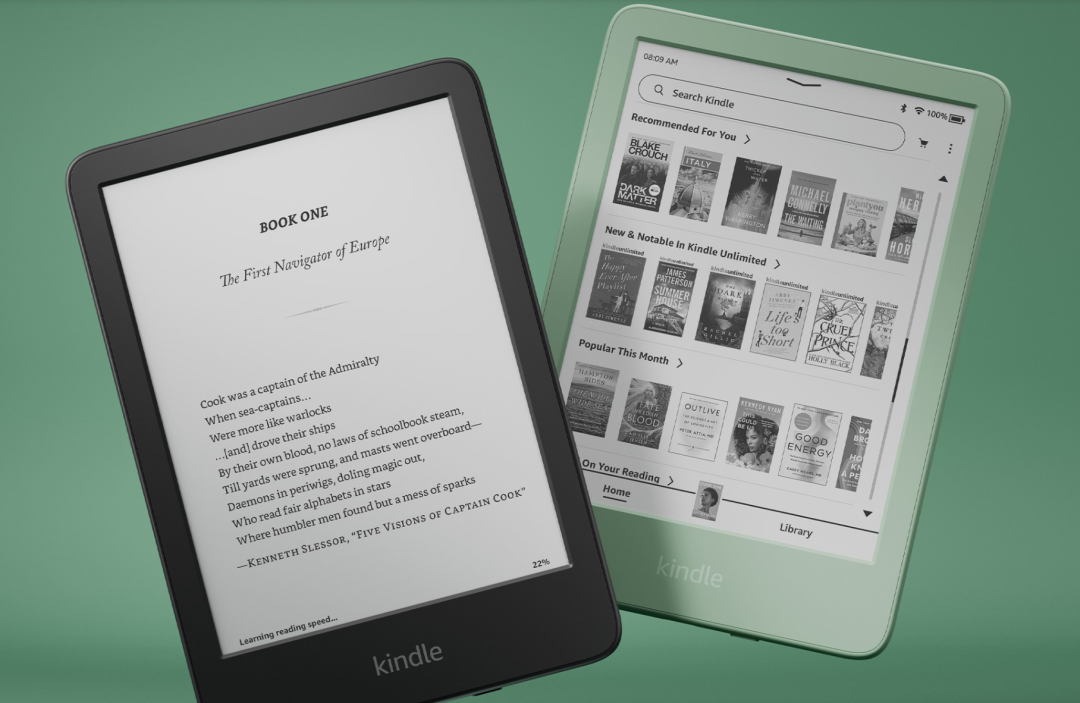


Every time I review a domestic e-ink screen, the comments section always spawns the same script: Kindle is the undisputed king of e-ink, beating all domestic manufacturers. Don’t argue with me—if you argue, you’re right.
It’s like some kind of scripted performance.
Debate is fine, but then you tell me to shut up; you unilaterally declare victory. That’s a slick way to claim a win.
I’ve written over 230 review articles and have never said any e-ink screen is flawless. Kindle is no exception.
Every e-ink screen is a product of compromise for its use case. None of them is a god.
Today, let’s break down how Kindle has become a “religious” brand in some users’ minds, and how fragile the logic supporting that perception really is when faced with reality.
Kindle was not the pioneer—it was a latecomer that rose to dominance.
Many people mistakenly believe Kindle is the pioneer of e-ink screens.
In fact, the pioneer in electronic paper is Sony: Jobs said it had no future, yet these “crazy” people quietly worked for 22 years and changed the reading habits of hundreds of millions.
As early as 2004, Sony launched the world’s first commercial e-book reader, the Sony Librie-1000, fully three years before the first-generation Kindle.
Sony was a corporate giant back then and was the first to commercialize electronic paper, but it later shifted to more profitable projects and stopped pushing hard on this line, leaving a window for later entrants.
Kindle seized that window and formed deep ties with E Ink, gradually climbing to the industry’s top position.
Another thing worth mentioning: Kindle’s initial pricing was not consumer-friendly.
If Kobo hadn’t prodded it from the side, the pricing would never have budged.
So competitors in the market are never a bad thing—consumers always benefit.
If Kindle were the only dominant e-ink brand today, you’d be spending far more than you did on the device in your hand.
The cost-performance illusion of selective comparison
The view that Kindle is the cheap go-to choice is often built on selective comparisons.
Many people habitually compare Kindle’s 6-inch model with domestic 6-inch products on price while deliberately ignoring the specs.
Take a closer look: the Kindle 6-inch Youth Edition uses the Freescale i.MX 6SoloLite, a single-core Cortex-A9 at 1GHz—an old, very weak chip—with a closed system and a cheap plastic body.
If this configuration were swapped for a domestic Qualcomm solution at the same tier, open Android, and more generous storage and battery life, the price would definitely be a good deal higher than it is now.
The 7-inch Kindle Paperwhite follows the same script: compare only size, not specs.
Honestly, how can you compare it that way?
Then look at the Kindle Scribe Colorsoft: an 11-inch color e-ink screen. The base 32GB model sells for $629.99, and the 64GB model for $679.99—roughly RMB 4,500 to 4,900, just about enough to buy an iPhone.
Why is no one saying Kindle is cheap now?
At the same size, domestic color e-ink office tablets have stronger specs and cost only a little over 4,000 yuan.
Yet Kindle, with its relatively weak quad-core processor, dares to sell at the 5,000-yuan tier.
Not to mention that firmware versions 5.18 and 5.19 directly forced the Kindle Scribe to require a hard restart using the power button just to work.
Who exactly is cashing in on the premium?
The immersion of closed systems and the inevitable trend toward openness
Open and closed systems aren’t really comparable—they’re just products of a particular technological stage.
Back then, Nokia took solitary pride in its Symbian system within its own territory and refused to open up, and was ultimately undercut by Android and Apple together.
Kindle now faces the exact same situation: 10 brands are besieging Kindle: domestic brands are going global like crazy.
It has to stick with a closed system because its business model is essentially built on selling content for profit.
But the direction of development never lies—openness will definitely defeat closedness; the tipping point just hasn’t arrived yet.
As for the claim that closed systems enable immersive reading, that doesn’t hold up to scrutiny.
Every e-ink device can give you an immersive reading experience. If software and notifications distract you, that’s not the device’s problem—it’s your own problem.
The device shouldn’t take the blame.
Immersion is the reader’s discipline, not a device spec.
Made in China: the real support behind the myth
Finally, let me say something that may offend: China can do without Kindle, but Kindle cannot do without China.
Pick up any Kindle you own and look at that line of English on the box: Engineered by Amazon, assembled in China.
Kindle’s hardware still relies on China’s supply chain for production and assembly.
If production were moved back to its home country, the high costs would directly drive away the vast majority of ordinary users.
The so-called cost-performance myth is essentially accomplished by standing on the shoulders of Chinese manufacturing.
We respect the pioneers, but there’s no need to deify commercial products.
Breaking the religious filter and objectively facing the hardware specs and software shortcomings is the attitude a rational e-ink player should have.
I like Kindle too, like the one below—to this day I consider it the pinnacle of industrial design aesthetics and mechanical buttons among e-ink screens. (You can tell how much I like it from how well I’ve kept it, and I own more than one of this model.)
But I also know that people need to look forward and not stay stuck in the past. (I’ll be posting a review of the device above soon; the mechanical buttons are quite fun.)
Original link: https://mp.weixin.qq.com/s/VALohS8D_nCmw4TNdr25bw